Wednesday, November 19, 2008

Form without function.


Farnsworth house is truly beautiful architecture. Designed by Mies van der Rohe for a prominent urologist, Dr. Edith Farnsworth. The house is a triumph of aesthetic design. Architecture books sing the house's praises and the architect's vision. And who can argue? It's complimentary relationship with the environment, the way the structure is approached, how it sits above the ground, its clean lines all validate the greatness of its design. So I suppose it should not be to impolite to ask, what was it like to live in this triumph of modernism?

Crap actually.

According to Dr Farnsworth:
The truth is that in this house with its four walls of glass I feel like a prowling animal, always on the alert. I am always restless. Even in the evening. I feel like a sentinel on guard day and night. I can rarely stretch out and relax…What else? I don’t keep garbage under my sink. Do you know why? Because you can see the whole “kitchen” from the road on the way in here and the can would spoil the appearance of the whole house. So I hide it in the closet further down from the sink. Mies talks about “free space”: but his space is very fixed. I can’t even put a clothes hanger in my house without considering how it affects everything from outside. Any arrangement of furniture becomes a major problem, because the house is transparent, like an X-ray

A night, lit up like a lantern and situated as it was in a forest, the house was a beacon to insects from miles around. Fly screens were not designed for the house, as it would have spoiled the purity of the design, so you couldn't open a window. In winter it was freezing, in summer a furnace. The personally selected marble on the entry steps needed to be scrubbed regularly since the falling leaves tended to stain it. It was unlivable.

A house's primary reason for being is to provide us with shelter and comfort. If a house is unable to do this it has failed in its function. As a machine for living in, it is broken. Yet architects continue to praise this house lavishly. A beautiful house that cannot be lived in; a triumph of form over function. The triumph of Modernism, the failure of modern Architecture.

Tuesday, November 18, 2008

Form follows function.

No it doesn't.

Engineering is one of those fields where economy and efficiency of materials are highly prized. It, perhaps more than architecture, lives to the credo of "form follows function". Buildings and other engineering works, must satisfy the need that that willed their creation. A bridge that doesn't carry the load is useless.

However this philosophy places form subservient to function which I feel is not its proper place. By this same philosophy, if form does not contribute to function, it is deemed useless and wasteful. The architects agreed, ornament is a crime declared Adolf Loos. In a world of scarce resources, putting more into a structure than what is needed is a waste, and perhaps morally wrong. Accountants and economists would heartily agree. Efficiency uber alles.

Now lets take a look at this from a real world view. From an engineering point of view, both these women are the same. Both are capable of reproducing, performing useful work and both are capable of holding a conversation. The fact that the fatter one will probably die earlier than the thinner one--it's not a given-- is irrelevant if the "design life" is calculated at 60 years. From a functional point of view, both these women are the same. Their form is irrelevant.


And yet they're not. Clearly, though both satisfy the engineering criteria, one is preferable to the other. Likewise consider two bridges.


Both fulfill the same function of carrying traffic over a road, yet clearly they have different form. Most normal people would see one the more desirable than the other. Function alone is clearly not enough.

In an age where life expectancy was so much less than today due to poverty, disease and famine, our forefathers still felt it was worthy to ornament a structure in such a way as to make it both beautiful and functional. Our society baulks at the the cost, we are indeed mean and miserable men

Form should complement function. To hell with the modernists.

Tuesday, October 28, 2008

Deals structured by cows.

Imagine a wealthy landowner (A) who has a herd of 1000 cows. Suppose this landowner was old and pre-occupied and found it difficult to look after his herd. A fellow landowner (B) hearing of his plight offers to borrow and look after his cows and give A 5% of their milk production.

A considers B’s proposition, he is old and tired and can’t look after the cows, by lending the cows out to B he still owns the cows and gets 5% of their milk production without any effort, upon consideration and agrees, except that he wants to be able to slaughter the occasional cow as needs arise and wants B to be able to give it to him on demand, B considers this and they agree.
B is an enterprising fellow. He has no real intention in looking after the cows at all. He is interest in making a buck. The word on the street is that milk is quite profitable and that people are prepared to borrow cows for 9%. Earn 9%, pay 5%, live off the spread. The 4% of the milk is his to sell at the market, its easy money. Now he knows that C is keen on looking after cattle at market rates B however realizes that A may want some of his cattle back on demand, so B lets C borrow 80% of the cattle, keeping 20% in reserve in case A comes a calling. It’s his fractional reserve.
C accepts 9% terms. C however never intended to milk the cattle, rather he wanted to trade them for some farm equipment which he wanted to grow crops with. He thought, if I grow crops I can sell them at market, buy some milk to pay back B and still make a profit. So C swaps his cows for farm equipment which D makes.
D doesn’t know what to do with cows. But he knows that B is paying 5% milk production for the use of cows. He can live off that quite comfortably and still slaughter a few cattle as required. He gives his cows to B by agreement and on the same terms as B is offering to A. B is an enterprising fellow, he realizes lending at 9% and paying at 5% is the path prosperity so he must keep pushing this good thing. B runs around looking for other people interested in borrowing cattle. At the market B finds E, who is willing to accept the same terms at C and so on. After 5 iterations of this scenario, B’s balance sheet looks like this:

Person Liabilities Assets Reserves
A 1000 cows @5% 800 cows @9% 200 Cows
C 800 cows @5% 640 cows @9% 160 Cows
D 640 cows @5% 512 cows @9% 128 Cows
E 512 cows @5% 410 cows @9% 102 Cows
F 410 cows @5% 328 cows @9% 82 Cows

Total: 3362 cows@5% 2690 cows @9% 672 Cows

Questions for budding economists:

1) Does decreasing the amount of amount of cows left in reserve, increase cow supply?
2) What is the cow multiplier when a reserve ratio of 8% is stipulated?
3) Does varying the rates of return, alter the supply of cows?
4) Does fractional reserve cattle banking, increase the number of cows?
5) Are borrowed cows destroyed when loans are paid back?
6) Are cows created by fiat when loans are made?

Thursday, October 16, 2008

Wednesday, October 15, 2008

The cause and prospective duration of the current economic crisis.

Net household savings.

It wont get any better till savings rates are between 5-10%. Australia and the U.S. will need all the help they can get, but God help New Zealand.

Wednesday, October 01, 2008

Postmodern accounting.

H.L Mencken was right, democracy is the greatest show on earth. Yours truly has been following the financial meltdown and political process as a spectacle to behold. This is better than the West Wing.

However the most depressing thing that strikes me about this spectacle, is the intellectual shallowness of most of the leading participants. From the President down to Joe Average, the level of economic idiocy is truly astounding. What is so distressing is that the aforesaid morons, through our political process, determine the economic course of state. Is it any wonder that we are having a meltdown.

I suppose its no suprise, that one of the most 'stupid' solutions to the current crisis should come from the very orginisations that distinguished themselves so well in the regulation of the idiot bankers. Apparently the FASB has now decided that the troubled assets don't have to be marked to market. The wise public servants have determined that we are having a firesale--it's been going on for eighteen months--and the prices that the market is paying for the "troubled securities" are under what they are truly worth. According to wise at the FASB, the current accounting rules significantly understate the value of these assets and hence adversely affect the capital position of the banks. As I understand it, the FASB has implicitly said that the assets should be marked at a value that they would represent in an "orderly market".

What the hell is an orderly market?

I presume it means a market that gives me the price that I want for my asset.

Now Suppose I have a Milli Vanilli Cd which I would like to sell, and that currently, the CD is selling on the open market for 5 cents. I actually think in a few weeks people will be looking back nostalgically at the Eighties and that there will be a demand for Milli Vanilli songs, therefore true value of the CD will be about 30 dollars.

How do I price the value of my asset? What is fair market value? Clearly what the FASB allows is for the holder of an asset to determine the market value of the asset independent of what it has been trading for on the open market. This is just plain dumb and they type of stuff that frightens off intelligent capital. More opacity at a time when no one trusts each other in the banking system.

How the hell do you read a balance sheet when the value of assets is determine by what management thinks is a fair value, as opposed to what the asset is trading for in the open market? Do think there is likely to be a conflict of interest?

I suppose with march of postmodernism through the humanities, it was only a matter of time till it crossed over into the weakest of the "sciences"; economics and its handmaiden, accounting. If various and conflicting readings of the "text" are equally valid, and truth is a construct devoid of any metaphysical basis, it should be no suprise that when reading a balance sheet the numbers put down can mean anything we want them to mean.

It certainly makes investing in this kind of market a very interesting proposition.

Monday, August 18, 2008

How to get a holiday in American Samoa.

Recently I've been reading about the Katyn Forest massacre. For those of you who aren't up to date with your World War Two history, the massacre was perpetrated by the Soviets(Allies) against the Poles(Allies) during the early stages of World War 2. Lots of people seemingly forget that the both the Nazis and the Soviets started the second world war by invading Poland. Russia is still a bit embarrassed about the Ribbentrop-Molotov pact. The Polish didn't have a chance.

After taking charge of the eastern half of Poland, those champions of the new world, the Soviets, murdered about 25,000 Polish military officers and intellectuals burying most of them in the Katyn Forrest. It was all hushed up and forgotten. However when the two branchs of socialism (National and Soviet) had their falling out, the graves were discovered by the advancing Nazis. This proved a godsend for Goebbels who used the communist atrocity for Nazi Propaganda advantage. The Nazi's even organised an international commission to verify that the Russians had killed the Poles. The international commission pretty much confirmed that the Russians had done it.

Things changed however when the fortunes of war changed, When they recaptured the area from the Germans they had their own commission set up, however in the interests of "objectivity" only Russians were allowed to be part of the investigative orginisation: can't trust those foreigners. Their commission determined conclusively that the Nazi's did it. The useful idiots on the Left believed them, no one else did.

The political winds by this stage had changed, the Soviet Union previously and enemy, was now an ally and as everyone knows, only Germans did bad things during the Second World War. However the American people were concerned about their Soviet Allies and felt a bit uncomfortable about having a friend who so recently supped with the Nazi's, so FDR sent a certain Naval Commander Earle to investigate the matter. Now Earle it appears, was not your usual fellow. Apparently he personally insulted Hitler by saying:

I have nothing against the Germans, I just don’t like you.”

Earle had been the Ambassador for Bulgaria, and using his contacts, he was able to determine that the Soviets had committed the crime. Now FDR did not like the conclusion he thought that the Soviets were nice. It appears that a lot of negative publicity with regard to the Soviets was hushed up by the Roosevelt Administration; if your an ally of FDR, you can do no wrong. Earle was reassigned to American Samoa for the duration of the war.

The Russians fessed up in 1990.

May the victims rest in peace.

Thursday, May 29, 2008

Human Shields.

I think that many of the moral problems that confound the average person have at their core a confusion between innocence and in culpability. Inculpability is not innocence; one can do wrong and not be deserving of punishment for it.

For there to be culpability there must be an evil act of the will(intent) or evil act; that is, a person's deserts are dependent on their acts An evil act in the absence of an evil will may render that person inculpable of desert evens though not innocent of the act. When we say a person "meant well", it usually means that they did something wrong but that their intent was good. In many cases it is as defence for actions which in themselves were deserving of punishment.

Consider a human shield. How do we evaluate the actions of a such a person even though they may be involuntary? Clearly a human shield is shielding a combatant, the human shield is performing a function even though it may not have been deliberately chosen. In the case of a terrorist advancing behind a human shield, the shield is "protecting" the terrorist and hence is complicit in evil albeit involuntarily. The shield is not innocent, it is inculpable. Armchair moralists please take note.

Now suppose a person is being coerced into an action which is morally wrong, what is the right course of action to take, given that failing to take that action will cost them their life? Traditional moralists have argued that we must not do wrong even at the expense of our careers or our life, we must love the good more than we love life. The proper action of a person finding himself as a human shield is to oppose being one, even if it costs them their life. Now I'm not saying that this is what I would have the courage to do, rather it is what should be done.

From the point of view of the person defending themselves from an attacker hiding behind a human shield, it would appear to be morally permissible to defend oneself from the attacker even though it may injure the human shield. In fact it would appear to be justified to directly attack the human shield in order to get to the attacker. The shield is an involuntary accomplice.
The problem of course is that in attacking the shield, we may be inflicting grievous injury on one that is undeserving and that in itself is an evil.

In choosing the correct course of action we must return back to the principles of double effect. Namely :
1) That our action(defence) is just.
2) That on balance the action will result in more good than evil.

Number (2) of course is the fly in the ointment as it is a prudential judgement and hence open to a wide variety of opinion. Sometimes there are no clear answers and we have to make the best of a bad choice in the fog of war.

Tuesday, May 20, 2008

The innocence of evil.

Several months ago there was a case over here which raised profoundly disturbing questions.

A local convenience store attendant was attacked by a knife wielding schizophrenic. The attacker was in a psychotic state and proceeded to grab the man in a headlock, soon a hostage type of situation ensued. Local bystanders called the police who arrived quickly. Upon their arrival the attacker became more agitated and started to stab the attendant in the neck, the police yelled at him to stop, which he did not do. At risk to themselves from the knife and under pressure to act immediately, the police shot the schizophrenic man who died at the scene. The attendant survived.

How does one morally evaluate the actions of the policemen and the schizophrenic man?

The schizophrenic man was clearly causing evil, He was actuating it. If innocence or guilt refers to responsibility of causation, then the man was guilty. But clearly the man's mind was diseased, so doesn't it offend reason to say that this poor fellow was as guilty of evil in the same sense that a murderer is? Many people would say that the schizophrenic man was an innocent victim. I would disagree.

Traditional morality would have separated guilt from desert. That is, it recognised that a person may not have been totally free to choose the action taken. Traditional moralists would have argued that while the person was guilty of evil he was inculpable. While he did cause harm, he did not know what he was doing, and therefore this person did not deserve to be shot. Causing death to an undeserving man is evil.

The police on the the other hand had an obligation to protect the life of the service station attendant and their own with the practical means available. They were trying to stop the schizophrenic man from stabbing the attendant, their intent was good. Furthermore one is morally justified in using deadly force if the circumstances permit. This was such a circumstance so the actions the police took were morally justifiable. The police performed a good moral action which had a double effect. It saved the life of an innocent service station attendant while it caused the death of an inculpable schizophrenic.

The bottom line is that situations can arise in which we are forced to do good, but that good may result in evil effects to undeserving people. More on this in the next post.

Monday, May 19, 2008

The wrong stuff.

I like to visit Alias Clio's blog from time to time. Recently she has been running a series of "Nice Guy" posts. There well worth a visit and worthy of some contemplation. As I understand it, she was writing about the "nice guy" from the feminine perspective.

I thought I would like to write my own nice guy story.

Several months ago a young man in his 20's--engaged in a creative profession--presented himself to my rooms with his mother.
He was having difficulty sleeping and had lost his appetite and weight His mother stated that he was moody and irritable, and would lock himself up in his room for hours at a time. She was concerned about his behaviour and was concerned that he may have been taking drugs. She was aware that he has was having problems with his long term girlfriend and that their relationship had recently been shaky. I asked him what the matter was:

"My girlfriend wants to break up"

He started sobbing. "It all began after she went to Europe. When she came back she had changed. She started wanting to go out more by herself. She wouldn't call as often and has been cold. I can't live without her(Gasping sobs), I bought her presents, roses and have done everything she wants me to do. I've even written poetry for her. If she leaves I don't know what I'll do". I asked him if he thought about suicide. He nodded his head and sobbed loudly. His mother looked at me grimly.

"How do I get her back? I'll do anything. I've tried talking to her mother to convince her to stay. Her mother is upset at her because she feels we are a good couple. "

Tears were rolling down his cheeks in a small torrent. I empathised with his situation. I too knew of spurned love and how deeply it hurt. But staring at him I felt nothing but contempt. Here was a man who was in his early 20's and had to be bought in by his mother because he was not coping, he was crying in a whining sort of way because his girl was leaving him, here was a man who was prepared to sacrifice his dignity for the affections of a woman who lost affection for him. In short, crying before me was a mummy's boy who had lost out in love. My response was calculated and said in low growling voice;

"Grow some Balls"

My words struck him as if slapped on his cheek, his mother nodded approvingly. I continued;

"You've have lost her already, she's staying with you because she feels guilty about dumping you but wants to break up the relationship without feeling bad about herself. She's not comfortable about hurting you, but she has lost all respect for you. She has probably got the hots for another man. If she calls you up, you respond in a measured tone. No anger, but let her know that she has let you down, do not whine. Find yourself another woman. If you get the chance, flirt with other women in front of her. Act like a man." His mother continued nodding approvingly.

I counseled him for a while and suggested that the best strategy to deal with his sorrows would be to find a new object for his affections. At the end of the consultation his mood improved considerably. As he was leaving my room he pulled a reflective expression and said:

" You know Doc, You're right. Just before she went to Europe she kept complaining that I was too nice to her and that she wanted me to be a bit rougher with her, I didn't know what she meant then but I guess I now understand."

I have seen him again. He has another girlfriend. He is happier and is now going to the gym.

Breaking up is hard to do.

A former Greenpeace founder gives his opinion on some of his former mates and thir policy ideas. I especially like the comment about policy being made by people who have no idea about what they are talking about. Makes for good reading.

Here.

(Hat tip. Climate Debate Daily)

Wednesday, May 14, 2008

How to come second in line for the Nobel Peace Prize

See this little old lady. I bet you don't know who she is.


Her name is Irena Sendlerowa. She has just recently passed away, but back in the Second World War she helped rescue over 2500 Jewish Children from the Warsaw Ghetto. To put this into perspective Oscar Schindler managed to save about 1200 people all up. She was captured by the Gestapo,had her legs broken in an effort to betray her cause but she stood firm. She even managed to escape the death sentence. After the war she returned to an ordinary life. You can read more about her here and here. She was nominated by the Polish Government for the Nobel Peace prize. The Nobel Committee awarded it to an environmental windbag, Al Gore.

The Nobel Committee is without honour.

Monday, May 12, 2008

Blessed are the Engineers.

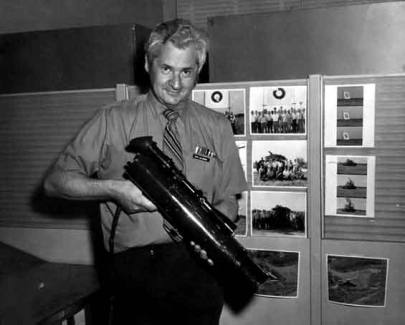
Not many people know who this man is.


His name is David Salonimer, an engineer who worked at the U.S army's Redstone proving ground. He is the father of the modern laser guided bomb. You have probably never heard of him.

His idea, with the collaboration of others has probably done more to reduce human suffering in warfare than any of the peace treaties or political gestures at disarmament since the Second World War. By improving the accuracy of weapons by several orders of magnitude he has spared countless people from becoming collateral damage. He has also probably spared many soldiers and airmen from death and massively increased the military power of his country. In this age of military barbarism he has probably done the most to lessen the miseries of war.

Part of the reason that that area bombing was implemented was because the accuracy of bombing was so low that an inordinate number of large high explosive bombs had to be dropped on a target in order to achieve a probable hit. Given that pinpoint precision is now a real ability of armed forces, military forces have now begun to use the weapon of David, albeit in a smart form. The smart rock.

This guy is an all out legend, yet no one knows of him. As far as I understand it he has won a few engineering awards but that is it. Al Gore gets to win the Nobel peace prize for being an environmental windbag while the man who actually save lives gets passed over. I personally feel he comes second to Henry Dunant in reducing the suffering in war. The world honours its sinners and passes over its saints.

Monday, April 28, 2008

Imprecise precision.

I wish to apologise to all. I have been away rather longer than I expected and I feel I have let duty slip. I will try to post more in the next few weeks.

Carrying on with the theme of double effect, here are a few facts worth pondering. A the end of the Second World War the U.S. conducted a review of the effectiveness of its bombing campaign. The report can be found
here.

During most of the Second World War the U.S pursued a policy of daylight bombing of specific targets of military value. Unlike the British who early on instigated area bombing due to their inability to hit a specific target at all. One of the interesting facts that it presents is that overall only 20% of bombs when aimed at a clear and specific target fell within a 1000 ft radius of the target. Where did the other 80% go?

In fact the average CEP of bombers in the WW2 was approximately 3000 ft.

Now, how do we morally evaluate the actions of the bombardier, who while aiming at a specific target, exposes approximately 5 square miles around the target to the possibility of being bombed? Clearly an attempt at discrimination is being made even if the effects are indiscriminate.

Tuesday, October 16, 2007

Keeping in touch.

I've been really busy the past few weeks and have also had some writer's block. I hope to have a few posts up in the next week.

Sunday, September 23, 2007

Imperfect acting

Before a person performs an action, they must have something in mind--the objective--which they intend to perform. The purpose of acting is to realise the objective. When we perform an act, we set out to achieve what our will wanted us to do. Now this might sound like stating the obvious and in one way it is, the problem is that when we try to achieve our objective we may cause other effects to come into being incidental to the realisation of our immediate objective.

Example: A man is involved in a motor vehicle accident. He has been flung out of his car onto the road in the path of oncoming traffic. He has also broken quite a few bones in his body. We happen upon the accident scene and try to move the man out of the path of oncoming traffic. Now in moving the man we cause him suffering and distress as every movement jostles his broken bones.

Now our objective is to move the man out of the path of danger, however in trying to perform this act we manage to move him out of danger while at the same time causing him considerable amount of pain. In actuating our objective we have also actuated this man’s pain. Now if we are aware that the man has broken bones we clearly foresee that the action of moving the man is going to cause him pain. How do you evaluate the determine the morality of an act when clearly both good and evil is happening at the same time as a result of a specific action?

Now our capacity to actuate our objective is limited to our means and circumstances. A elderly man may want to help our injured motorist but not have the strength to do it. A young lady may drag our motorist across the road, causing more pain than if he was gently lifted by paramedics yet both people have tried to actuate a morally good objective with various degrees of evil resulting as a result of their circumstantial limitations.

The prevalent view amongst a group of quite a few Christians--who should know better--is that the act is evaluated on the consequences, if one of the consequences is a foreseen grave evil then the act’s nature must be intrinsically evil and hence prohibited. The act is judged by its effects. By their reasoning, if a man performs an action in which he foresees his own death he must have intended suicide. If a pilot of a plane bombs a building in which terrorists have used hostages as shields he must have intended to kill the hostages. It is the doctrine of immaculate actuation.

They will of course deny that this is their reasoning and this is because they cannot see their error. All of them can state the principles of double effect and list examples of how they support it; up to a certain point. Once a certain psychological threshold is crossed, double effect is negated. While it is never OK to deliberately actuate pain or maiming to an individual as in torture they will quite happily accept it as a side effect of medical treatment. However once the unintended evil effects of an otherwise morally permissible action include injury to children or death to innocents then the principle of double effect usually is switched off: Double effect is applicable up to a certain threshold of unintended evil after which it is not on.

Now this is basically a repudiation of Veritatis Splendor. The document states that the morality of an act is determined by a moral analysis of the actors corporeal objective, not the effects of the realisation of the objective. The question to be asked is what was the actor trying to achieve by the action which resulted in both good and evil effects? The fact that a good action may have a bad effect does not automatically disqualify the action. St Thomas will back me up on that one.

Veritatis Splendor did not deal with the doctrine of double effect explicitly but its principles are easily applicable to the doctrine. In order for an action to be licit under the principle of double effect:

The actor must have a good moral objective and
A proportional analysis of the effects of actualisation of the action must on balance be good in order for the action to be permitted: The doctrine of double effect is the doctrine of conditional proportionalism.

The doctrine of double effect does not permit an actions which have a morally good objective but which on balance has bad consequences. Likewise double effect does not justify a morally bad objective if the consequences are good. Double effect also implicitly demands that we chose actions which minimise the bad consequences where that choice is available.

Monday, September 03, 2007

Moral Object Solutions.

Apparently My Blog is being read in heaven; no seriously. I got two replies to the Double Effect post from John Paul II (check the comments on the post) I do get an impressive audience. I wonder if it is a wireless link?

I’d thought I’d have another go thinking about moral objects.

What is a moral object?

One of the big problems in understanding morality is an understanding of the concept of the “moral object“. I’ve gone looking around on the web and have been mulling over Veritatis Splendor and most explanations seem to go give a partial understanding of the subject. I also feel that Veritatis Splendor may confuse the terminology a bit. Thinking about the matter a bit more, I feel that the military may have some useful ideas in helping us understand the moral object a bit easier.

The target of a military endeavour is called the objective. The objective is the thing to which military activities are directed. Military endeavours are usually divided into two different types of objectives: The strategic and the tactical.

The strategic objective is the purpose to which all military operations are directed. Principally they are the defeat of the enemy or a lessening of its power. Broadly speaking it is why military operations are constituted in the first place. The tactical objectives and the targets which have to be achieved--either in the form of possession, neutralisation or destruction--that have to be achieved in order to achieve the strategic objective. Now the strategic objective can be thought of analogous to the idea of intent while the tactical objective can be thought of as the objective of an act.

Notice that there are two different types of objectives. Intended objectives and objectives of acts. Both acts and intents have objectives but they are fundamentally different in their natures. The intended objective is a state we wish to achieve, this state may come about passively without us doing anything while an the objective of an act is a state we wish to achieve by our active participation.

This objective can be considered from many different perspective but when considered against a moral standard the objective can be thought of as a moral objective. The moral object can therefore be thought of as the classification of an object with respect to its relation to God’s moral law. Example: Let’s say A wants to murder B. The object of A’s intent is the unjust death of B. As it is never licit to murder, the object of A’s intent can be thought of as contrary to God’s law and therefore is categorically evil. A’s intent has an evil moral object. Broadly speaking bad intentions and bad acts have are bad moral objects, while good intentions and acts have the opposite. Moral theologians have also made the distinction in the following terminology:

The finis operis: the end of the operation , similar to the concept of the tactical objective,
The finis operantis: the end of the agent similar in concept to the strategic objective.

Personally, I think that the terminology doesn’t emphasise the distinction enough, so I ‘m suggesting a different terminology be used. (I’m open to suggestions of a better terminology).

Finis operis: Corporeal object.
Finis operandis: Intended object.

I want to be clear that by corporeal object, I mean human acts including thoughts; for thinking is a human action even though it is not strictly corporeal.

Now human acts can be considered as being directed towards a specific corporeal object. Human action is the ontic realisation of the corporeal object: The thing willed is made real by the act.

Now why does all this matter?

At any given point or place the universe as we know it exists in a certain ontic state. By ontic state I mean the bits and pieces that make up our universe have a specific relation to one another. The universe as it was on June 22nd 3.05pm exactly was in a different ontic state to what it was on Feb 12 1987 at 11.37 am.

Now the intent concerns itself with the nature of the ontic state, or the type of state the particular individual would like to see exist. The object of intent is a particular ontic state; while the corporeal object realised, is an active alteration of the ontic state: the act generates a particular ontic state. The important point being is that the corporeal object and the intended object are not the same. Sometimes the corporeal object is congruent with the intended object sometimes it is not: the corporeal object--with the contingent assistance of circumstance--is a means of attaining the intended object.

I think a change in terminology is important because ill will in discussions on moral matters frequently hinge on definitions, the current definitions are not precise enough. More tomorrow.

Friday, August 24, 2007

Thinking about Hiroshima.

“What guided me in my thinking and guided all our efforts—The reason the 21st Bomber Command worked like no other command during the war and kept us going—was the million men we were going to loose if we had to invade Japan. That says nothing of the Japanese losses, although we didn’t give a damn about them at the time. We were primarily worried about our own people”

Curtis Le May.

I’ve been watching with dismay the two opposite lines of reasoning evidenced at VFR and WWWtW.

It would appear to me that Laurence Auster is putting forward an argument that the ends justify the means. The Japanese were wicked, tenacious and determined not to give in no matter what the price. The dropping of the bomb instituted events which stopped the war quickly and saved many lives, Japanese and American; this interpretation is consistent with the facts.

The position of WWWtW is that the attack on Hiroshima is wicked because innocent civilians were killed. As I have argued previously the position of the main protagonists on WWWtW leads to functional pacifism. The criteria that they set up for the fighting of just war make it effectively impossible to fight. Furthermore their thinking opens a line of tactical exploitation by wicked people. Tie up an innocent to your tank, plane or whatever and it is immune from attack on the basis of the moral argument put forward by WWWtW.

Both approaches are wrong and both are wicked.

Following my line of reasoning from yesterdays post I would like to make an analysis of the atomic bombings within the Christian tradition.

Auster's argument is quickly dismissed. Christian tradition has always condemned the line of reasoning that wicked means justify good ends. That ends that argument.

Now I feel that the atomic bombings were wrong but not for the reason the people over at WWWtW do.

Firstly the state has authority to bear the sword in defence of the common interest. However the state is allowed only to attack the unjust (aggressors) and their means, it is not allowed to attack the innocent. Now any enemy city is going to contain a mixed bag of the innocent and combatants, the concept of deliberately targeting a city itself, is morally wrong since by definition it would be an intended attack on both the innocent and the guilty.

However, we are allowed to attack the unjust and if in the process, innocent civilians are killed unavoidably, then the action is permitted according to Christian tradition. It would appear therefore that the attack on Hiroshima was justified, as Hiroshima was a major military base as well as Nagasaki.

However double effect is a two edged sword and the mechanism that permits collateral losses also obligates their minimization. The question to be asked then is, did the U.S. have a capacity to destroy the military installations of Hiroshima without using the atomic bomb? The answer to that is unfortunately yes.

The Twentieth Air Force had the capacity to destroy whatever it wanted on the Japanese mainland. Towards the end of the war it was safer in a B-29 flying over Japan than in a training mission over the United States. General Curtis Le May felt at the time that the action--dropping the bomb--was unnecessary, as did Admiral Arleigh Burke; the two men who were putting most of the hurt on Japan. Had the 20th Air Force gone in to firebomb Hiroshima, perhaps twenty to forty thousand would have been killed, but that means that the sixty thousand extra who died as a result of the atomic bomb would not have been. The option to minimize civilian losses was available and it was not chosen, therein lays the evil.

Had the U.S. no other way of defending itself against attack except by nuclear weapons then I believe it would have been justified in using them, provided they were targeted at military targets only and with an eye to minimizing civilian casualties. The problem was that no one cared about the Japanese, no one gave a damn. In fact Hiroshima was also seen as an experiment, the fact that it had remained deliberately unscathed with a view of it being a test city for nuclear experiments shows just how degraded the concern for the Japanese had become, the citizens of Hiroshima were to be the guinea pigs of atomic warfare.

Truman did agonise over the civilian losses that the bombs were going to produce; I do not stand in judgment of him. He was a fundamentally decent man and I believe that when he made the decision to drop the atomic bomb, he did so with a good and hence binding conscience. I live in a different time and benefit from the freedom his actions provided. Free from the pressures, sorrows and anxiety of war, I and others can dispassionately reflect on the situation with the benefit of hindsight; which by its nature is always crystal clear. Truman did not enjoy that privilege.

Every society should make a moral accounting of its conduct and if it finds itself wanting, ask for forgiveness from the Almighty and determine not to repeat the same mistakes again. Our Christian tradition reasserts that we should choose to suffer death rather than perform evil. Death before dishonour is not just the motto of some fanatical Japanese; it is also the motto of the Christian soldier.

Thursday, August 23, 2007

Double trouble with double effect.

I’ve been pondering double effect for a while and thanks to the moral definitions in the previous post, I feel I have a better understanding of the phenomena.

Firstly when one acts one brings something into being: Something is made real through the act of the will. By running I make my intention of going for a run real. The things that are actualized in this world can be good, bad or indifferent.

When one performs a good act one wants to bring something good into the world. When one an evil act they causes an evil in this world. But what happens when one brings about an action which brings about both good and evil at the same time?

How does one form a moral assessment of surgery, in the days prior to anaesthetic? When the knife is put into the flesh, curing the patient (good) begins at the same time pain(evil) and mutilation(evil) is actuated. To deliberately cure someone is good, to deliberately hurt someone is evil, then how do we evaluate the morality of surgery if intrinsic to its actuation, good and evil result?

The Christian tradition stated that the moral species of the act is determined through its moral object: what was the moral quality of the “thing” realized through the act. Example; putting a dent in a brand new car--as in an act of vandalism--is evil, since by denting a car, it is privated in some way. The moral object of an act concerns itself with the moral quality of what is bought about by the act, not why the act was done.

Now according to Aquinas one does good when one actualizes a good, and one sins (peccatum) when one actualizes an evil; now sin in this context is non-pejorative. A man sins and does good when he performs an action with a double effect. So how to determine its permissibility or not?

Christianity has stated that acts which bring about a state with a mixed moral quality are permitted provided:
  • That a person may choose to act in a way which results in mixed moral objects provided that the person is choosing the good moral object.
  • The mixed moral quality of the act must on balance be good. A proportional assessment of the act has to be made and the result must be in favor of the good. In sum, a net good is achieved by the act.

Now a man is culpable for the things he has control over not for the things he doesn’t. In choosing an act which actuates mixed moral objects, one cannot be blamed if the evil moral object is bought about, not through any choice of the agent. He is inculpable. However if the evil moral object could be avoided in some way then the agent becomes culpable because he has some choice in what type of evil is bought about. No choice, no culpability. There is a double imperative in Christianity: do good and avoid evil.

Sunday, August 19, 2007

The Good Conscience

I thought I would post a link to an interesting speech delivered by Bishop Anthony Fisher of the Catholic Church here in Australia. Bishop Fisher is one of the most conservative Catholic bishops out there and a strong defender of orthodoxy. His comments on conscience are quite nuanced. They can be found here.