Thursday, May 19, 2016

Sam Francis: Beautiful Losers.


I've got to admit that while I had heard of Sam Francis before I really didn't delve much at all into his writings, and it was only a recent article and some commentary over at Radix which further piqued my interest in him, and I must admit, I've been mighty impressed. Over the last few weeks I've been reading some of his works and am of the opinion that the Dissident Right needs to pay much more attention to him.

It's a shame that Sam Francis died relatively recenetly, on the verge of the blogging revolution. Were he still alive, I imagine he would have carved his own niche in the Dissident Right and become a formidable force shaping it. I am of the impression that he didn't always agree with the tone or the official positions of many of the journals he wrote for, but given the state of affairs that existed prior to the widespread use of the internet, he was limited to writing for the increasingly few journals--on the margins--that would publish him.  Journals which, frankly, I don't think were up to his standards.

His banishment to the margins, by the forces of political correctness, I imagine was their way of denying him conventional legitimacy and smearing him as a unbalanced and someone not worthy of serious consideration. 

And yet he is.

Francis is different.

Unlike most conservative commentators who simply push for a reset to the past, Francis realises that this isn't going to happen, and if the Right wants to end it's near century losing streak its got to start doing things differently. Though coming from the Paleoconservative faction of American thought, Francis was heavily influenced by the writings of James Burnham, author of the Managerial Revolution, and this in turn influenced his analytic method when it came to understanding the sociological aspects of the liberal/conservative conflict. Burnham was an empiricist of power, both in an understanding how it was wielded and how it was gained. Francis took these ideas and placed them within the Paleoconservative context. He sought to apply these principles to analysis of the American conservative movement and his thoughts, I feel, are applicable to contemporary times.
However sophisticated and well expressed conservative intellectualism may have been in the years after World War II, its virtues did not assure it victory, mainly because there existed in American society and political culture no significant set of interests to which its ideas could attach themselves. Hence, post-World War II conservatism in its political efforts generally ignored the philosophical contributions of its highbrow exponents and fell back on the more mundane considerations of low taxes and small budgets, anticommunism and law and order; and the preoccupation of the Old Right mind in that era with an abstract and abstruse intellectualism helped ensure its eventual irrelevance. For the most part, any suggestion that the savants of the Right ought to have attended to the concrete social, regional, and ethnic dimensions of the human and American conditions rather than to their purely philosophical aspects was greeted with accusations of "determinism," though why it is less deterministic to say that ideas, rather than nonintellectual forces, are the major causal agents in human affairs has never been clear to me. The truth is that, for all their talk about social "roots," conservative intellectuals in the postwar era were often rootless men themselves, and the philosophical mystifications in which they enveloped themselves were frequently the only garments that fit them. 
Alienated from the prevailing intellectual and political currents as well as from traditional social forms that were ceasing to exist or cohere, the conservative intelligentsia was able to find explanations for and solutions to the civilizational crisis it perceived only in the most esoteric theory, and the "practical" applications of such theory often took the form of some species of romanticism or archaism--a pretentious medievalism, accompanied by antimodernist posturings and colored with a highly politicized religiosity; an attraction to archaic social and political forms such as the antebellum South, the ancien regime of eighteenth-century Europe, or the era of nineteenth-century laissez-faire; and a distaste for and often an ignorance of American history that derived from a mirror-image agreement with the Left-liberal understanding of America as an "experiment" dedicated to an egalitarian and progressivist proposition. If the intellectuals of the Right did not adhere to some form of archaism, they tended, like Whittaker Chambers, simply to withdraw from the world in despair and acknowledgment of defeat.
Sam Francis was not a Traditionalist. For Francis, the old ways did not work, the task was how to win, but before doing so, it was important to understand why the losses kept accumulating, hence his book Beautiful Losers, which is essentially  both an understanding of the failure of the Conservative movement and some ideas to get it out of the cycle of defeat.  The book is a collection of essays that he had penned for various journals with an accompanying introduction explaining his choice. Most of the essays are stand alone pieces but are unified in his "Burnhamite" analysis. Francis was acutely aware of the dissolution occurring about him and was convinced that the conservative approach had to change if there was to be any push-back.

Any objective look at the state of Western Society would show that there is not much further we can go in the slouch towards Gomorrah and given the relentless Left-ward drift of society. There's not really much more time left before the "right culture" of the West becomes a memory or effectively erased. New approaches are required.
It remains possible today to rectify that error by a radical alteration of the Right's strategy. Abandoning the illusion that it represents an establishment to be "conserved," a new American Right must recognize that its values and goals lie outside and against the establishment and that its natural allies are not in Manhattan, Yale, and Washington but in the increasingly alienated and threatened strata of Middle America. The strategy of the Right should be to enhance the polarization of Middle Americans from the incumbent regime, not to build coalitions with the regime's defenders and beneficiaries. Moreover, since "Middle America" consists of workers, farmers, suburbanites and other non- or post-bourgeois groups, as well as small businessmen, it is unlikely that a new Right will make much progress in mobilizing them if it simply repeats the ideological formulas of a now long-defunct bourgeois elite and its order. The more salient concerns of postbourgeois Middle Americans that a new Right can express are those of crime, educational collapse, the erosion of their economic status, and the calculated subversion of their social, cultural, and national identity by forces that serve the interests of the elite above them and the underclass below them, but at the expense of the middle class. A new Right, positioning itself in opposition to the elite and the elite's underclass ally, can assert its leadership of alienated Middle Americans and mobilize them in radical opposition to the regime.

A new, radical Middle American Right need not abandon political efforts, but, consistent with its recognition that it is laying siege to a hostile establishment, it ought to realize that political action in a cultural power vacuum will be largely futile. The main focus of a Middle American Right should be the reclamation of cultural power, the patient elaboration of an alternative culture within but against the regime—within the belly of the beast but indigestible by it. Instead of the uselessness of a Diogenes' search for an honest presidential candidate or a Fabian quest for a career in the bureaucracy, a Middle Amierican Right should begin working in and with schools, churches, clubs, women's groups, youth organizations, civic and professional associations, local government, the military and police forces, and even in the much-dreaded labor unions to create a radicalized Middle American consciousness that can perceive the ways in which exploitation of the middle classes is institutionalized and understand how it can be resisted. Only when this kind of infrastructure of cultural hegemony is developed can a Middle American Right seek meaningful political power without coalitions with the Left and bargaining with the regime.

Eliot may have been right that no cause is really lost because none is really won, but victory and defeat in the struggle for social dominance have little to do with whether the cause is right or wrong. Some ideas have more consequences than others, and those that attach themselves to declining social and political forces have the least consequences of all. By allowing itself to be assimilated by the regime of the Left, American conservatism became part of a social and political force that, if not on the decline, is at least confronted by a rising force that seeks to displace it, even as the regime of the Left displaced its predecessor. If the American Right can disengage from the Left and its regime, it can assume leadership of a cause that could be right as well as victorious. But it can do so only if it has the wit and the will to disabuse itself of the illusions that have distracted it almost since its birth. 
I imagine that Francis would have cheered the Donald Trump movement if not Donald Trump himself, though I image he would be more pessimistic of his success given contemporaneous circumstances in which his success is occurring.

I really both enjoyed and found this book thought provoking.  Over the next few weeks I plan to put up a commentary on some of the essays from the book and offer my opinion on some of his analysis

Once again, I'd recommend it and I feel that every Neoreactionary should have it on his bookshelf.

Monday, May 16, 2016

Potpourri.

Just a couple of interesting things I found on my blog travels this week.

Firstly, a good YouTube video by Black Pigeon on the subject of the negative effects of multiculturalism.

Unlike the usual slouch towards and trying to establish a racial hierarchy, Black Pigeon avoids the subject all together and simply concentrates on the societal problems of highly diverse populations groups. Bit long but worth a view.


Brett Stevens put up a very good post which I felt dealt with the subject of racial diversity quite well.
In the South — otherwise known as the part of North America with culture and honor — we settled this by having separate neighborhoods. Whites live in one place, Africans another, Mexicans another still, and Asians somewhere else. Balance is maintained because each group rules itself.

I always offer up the question: if you are African-American, and you get pulled over by a police officer, what type of face do you want to see? The answer is African-American. Same as whites want to see white police officers, Hispanics a Hispanic police officer, and Asians a (rare, but committed when it does occur) Asian police officer.

The fact is, that if we have control over our own communities, we are not enemies but distant friends. I like the “distant friends” idea because it enables me to enjoy people without insisting they be like me. White standards work for white people… for others, well, who knows — it’s up to them.
I'm not sure that the South "worked". To quote Roissy, Proximity and Diversity= War and even though there was state enforced segregation, the reality of running it resulted in a festering social wound. Still, what I like about Steven's article is that it doesn't aim at racial supremacism but simply the recognition that groups are different and that we can like people from other races whilst still wanting ethnic homogeneity.

Unlike most bloggers on the subject of the negative effects of multiculturalism, my criticism of it is not based upon racial superiority lines, rather its based upon an understanding of human nature and its hard wired cognitive biases for ingroup/outgroup distinctions. 

On the subject of the Alt-Right, West Coast Reactionaries have put up a fantastic post with lots of links expressing concern with the direction it is taking.
The reason why it is important to consider how the Alt. Right is being seen by the outside world is because what the outside world will see depends on who is being the loudest. And going by how increasing numbers of outsiders are viewing the Alt. Right, it is not looking good.
It is not all “just a joke”; there are various spheres which comprise the Alt. Right, and some may lean towards irony and the like more than others, of course, but the network in its totality is coming to only represent such spheres. Do not get me wrong, there will always be hardline intellectuals in any community of this sort, but ordinarily they exercise a deal of influence and prevent their community from moving beyond their confines. However, the Alt. Right is growing in size rather exponentially due to the Trump phenomenon and the migrant crisis in Europe, thus it is impossible to maintain a single orthodoxy over the masses of anti-SJW teenagers.
Andy Nowicki also puts up a good post dealing on the subject (bit long though) but worth listening to. The smarter guys seem to recognise that the dissident Right can't be a "big tent" which takes in everyone who opposes the left.

Sunday, May 08, 2016

The Left, White Nationalism and the 1488'ers


Perhaps the most interesting meta-political development over the past few years has been the rise of the dissident Right. It still in its early stages but it appears that several media outlets have begun to notice and no doubt, so enough, a concerted campaign will be mounted to to discredit it.

The traditional pragmatic approach of the Left, in dealing with it opponents, is to label them all as fascists or Nazi's wherever there is some doctrinal disagreement which they wish to emphasise. It needs to be understood that here the aim is not to logically justify that assertion as much it is to reinforce an association in the minds of cognitive misers, who are the majority in a democratic body politic.  As readers of this blog will note, cognitive misers, think in terms of associations so  Left psychops are intended to  primarily work through the limbus and not the mind itself.

As advertisers have long noted, positive associations with a product are far more effective in selling it than a logical explanation of its virtues.  What has hampered the Right in its battles against the Left is the traditionalist anthropological fallacy which saw people as rational actors instead of cognitive misers. The Right, in trying to combat the Left, has perused a strategy a logically refuting through data and argument on the assumption that ideas will prevail.

This assumption was wrong.

Sam Francis explains:
My conclusion that conservatism has transformed itself into virtual extinction will surprise and perhaps even anger those who favor the formalistic and normative approach, which does not easily stoop to considerations of social change and historical fluctuation and is reluctant to admit that some things, even ideas, fail. Regarding political events as the earthly manifestations of timeless abstractions, the intellectual mainstream of the "Old Right" from the end of World War II developed a highly sophisticated body of ideas and a highly articulate body of spokesmen to express them. Perhaps because they were too uxoriously wedded to Weaver's principle that "Ideas Have Consequences," most of the conservative intellectuals who subscribed to this body of thought always seemed to assume that it was only a matter of time before their own beliefs would creep up on the ideas of the Left, slit their throats in the dark, and stage an intellectual and cultural coup d'etat, after which truth would reign. [ED] I have never thought so, in part because I have less faith in the power of intellectual abstractions than most of my conservative colleagues. The historian Lewis Namier remarked that "new ideas are not nearly as potent as broken habits," and Burnham, describing Vilfredo Pareto's view of human rationality, wrote that "rational, deliberate, conscious belief does not, then, in general at any rate, determine what is going to happen to society; social man is not, as he has been defined for so many centuries, a primarily 'rational animal.' In the tradition of Namier (who briefly studied under Pareto) and Burnham, I place more emphasis on the concrete forces of elites, organization, and psychic and social forces such as class and regional and ethnic identity than on formal intellectual abstractions and their "logical" extrapolations as the determining forces of history. Ideas do have consequences, but some ideas have more consequences than others, and which consequences ensue from which ideas is settled not simply because the ideas serve human reason through their logical implications but also because some ideas serve human interests and emotions through their attachment to drives for political, economic, and social power, while other ideas do not.
The latest findings of cognitive science further buttress this view. The way to control the masses is not though the mind but through the primal limbic drives, and the Left, for all its talk of rationality, has recognised this fact, and pragmatically always concentrated its efforts on getting the proletariat to  "feel the strength" of its arguments instead of logically assessing them. Hence the aim of the Left has been to positively align its objectives with positive limbic sensations and hence the importance of its ideas and its causes being cool, hip, compassionate and trendy are more than them being factually correct. And its approach, I believe, has gone a long way towards its triumph over conservatism. Conditioning, not argument, is the way to sway the masses. Orwell's definition of "bellyfeel" in the Newspeak dictionary makes this same point.

Conditioning, however, requires the co-opting of pre-existing tendencies of the human psyche and associating them with the product. Goebbels for instance, ordered that depictions of the Jews in German propaganda to always be in the negative and to associate such depictions with other negative imagery such as rats and filth. The idea being that the negative associations be strengthened by such methods. However, there is a limit the power of such a technique and German propaganda was quite clear never to show the Jews being mistreated in any bestial form or manner because by doing so you generate sympathy for your victim and the intention to demonise him fails.

Conditioning is one of the most powerful mind control mechanisms since it operates at the level of the modus operandi  of the cognitive miser: Associative Cognition.

The Left has always recognised that for the average Westerner, the Nazi "brand" is associated with the worst forms of evil in the 20th Century and therefore it has always tried to smear its opponents as Nazis. The idea here being not to prove the logical connection but simply to reinforce the association so that whatever their opponent stands for, their idea becomes associated with the negative emotional state that comes with contemplation of Nazism. Of course sometimes the association is so out of kilter that the slur fails, but the failure rests on a clear ability to recognise the mismatch between the slur and the target. But what happens if the distinction is not so clear?

Suppose the target is actually quite sympathetic to Hitler, suppose when you Google the target quite a few Nazi images show up, suppose your obsessed with the evil of Jew's, how clear is target distinction then?

It isn't and the Lefts claim gains traction.

The terrible thing about the Nazi's, is apart from their terrible crimes, is that they seriously weakened the West's capability of withstanding Leftist attack by tarring all the elements of their ideology with the stench of evil through association.  Nationalism, did not produce the concentration camps in the First World War,  yet post war it has become associated with it.  Prussian Militiarism, which was honorable prior to the Second World War, through its association with Nazism degraded all further virile aggressive defence and the standing of the Military in the West. The Nazi's greatest legacy may be that they were able to weaken the good ideas of the West by association with the evil they wrought.

If, the dissident Right wants to bring back some of these ideas, things such as nationalism, ethnic homogeneity, virile masculinity etc, it needs to disassociate them from the associative links with Nazism that they have have established in Western Culture. The thing is that the Left wants you to think that all White Nationalists are Nazis and the the 1488'ers want you to think the same. They both have the same objective.


Sunday, May 01, 2016

Human Nature and Political Society.


I've been meaning to reply to commentator Tom for a while now with regard to a comment he left over at this post:
Of course, homophily exists, but given the massive harm it causes to humanity as a whole, I see no reason to mold society to it any more than I see a need to cater to other natural emotions such as violent jealousy[ED].

There are a ton of human impulses that society suppresses, and because man is a product of both nature and nurture, such impulses are heavily modified by experience. I'm sure that if I wasn't raised in Toronto, a heavily multicultural city, I'd be slightly discomfited by my workplace where there is no majority race, I hear Arabic, Hindi and Russian spoken around me, and the clothing styles, while majority jeans and polo shirt, also include Hijab/Abaya and the occasional sari.

Nobody here (a programming shop) blinks an eye because this is what you see every day on the street.

Yes, there are fewer cultural touchstones with my coworkers, so I exercise some cultural homophily with my personal friends (we're all hard-core computer geeks from a variety of races), but surely homophilic tendencies are no basis for the structure of society.

Or should I be agitating for a society where everyone must have read the science fiction greats before getting citizenship?
Whilst I respect Tom's comments, the comment above is in many ways akin to the argument pushed by feminists that a woman should be able to wear whatever she wants and not expect to get sexually assaulted.

Let me explain.

Traditional human anthropology tended to divide nature into its rational and irrational components. The irrational components being our appetites, desires, biases and other tendencies which overarching reason was mean to regulate for our own good.

Now the problem with this approach is that the concept of "reason" was rather vague. The implicit assumption was that the "reason" of the philosopher was also the same "reason" of the prole. The problem, as modern psychology and cognitive science has demonstrated, is that while everyone is capable of reason, the "quality" of everyone's reason is not the same.

An aspect of psychology that is relevant in this instance, is that of Kohlberg's theory of moral development. In essence, Kohlberg demonstrated that people's motivation for moral action is varied. At the lowest--and most populous level-- moral action is based on the avoidance of punishment and the promise of reward and its only that and only at the rarefied level of the enlightened few that it is motivated by considerations of higher ethical principle.  In other words, the reasoning of the bottom is different from the reasoning at the top yet the observed behaviour is the same.*

 
The other relevant dimension here are the latest findings from cognitive science which show that most people are "cognitive misers", even those with high I.Q., and that intuitive "logic" is default operating mode for most people.

When you meld these two findings together you find that most people's daily operations are intuitive in their nature and constrained by external factors such as punishment or shame rather than "considered behaviour modulated by rational deliberation". Sure, there are people like that, but they're in the minority.

It follows therefore that if you want the masses to behave properly, especially when asking them to act in ways which are profoundly counter-intuitive, pragmatically you need to have a strong policing force i.e. state retribution or strong cultural shaming mechanisms, i.e. institutionalised religion to keep people in line.

Expecting everyone to "reason" like a moral philosopher is based upon the assumption that everyone can. This of course is a rehash of the radical equality principle of all men and fails to recognise that some men are limited in reaching this level of cognition. (Note, it's one of the ways mainstream Christianity inadvertently laid the groundwork for Liberalism.) So anyone pushing this agenda is, in a way, furthering the intellectual supposition that all men are cognitively equal.

But suppose you do accept the fact that there is an inherent intellectual inequality amongst men, how then do you regulate public morality in such an environment, especially when asking men to act in a strongly counter-intuitive way? The only way to do so is by having a strong external apparatus, i.e. Church or State threatening to punish wayward behaviour. i.e. Big Brother.  Furthermore, with the collapse of "cultural constraints" the void for regulating behviour needs to be assumed by the state, thus,  radical liberalism necessitates a powerful state regulatory apparatus to provide a check against the intuitive tendencies of the masses.

This is a "high energy" state of affairs. The state needs to be constantly maintained and strong in order to keep society together, should the state falter the intuitive impulses of the masses will reassert themselves. In countries like the U.S., where there is greater degree of individualism and multiculturalism, when the lights go out and the police go on strike, anarchy starts brewing quite rapidly. On the other hand, in countries such as Japan, where there are strong cultural "policing" mechanisms, and more realistic understanding of human anthropology, failure of state does not necessitate a failing society.

The former Yugoslavia was a classic example of this. Comprised of six different ethnicities, most of which did not want to live with each other, the only way the state could be kept together was through a strong totalitarian regime. Interestingly, the people most able to "get along" where the educated "cognitive" types whilst the masses maintained their grudges.  The failure of the policing state meant that natural demographic forces could assert themselves,  the rest is history.  Yugoslavia failed because it needed a strong state to force Croats, Serbs and Slovenes to be Yugoslavs and it was an example of trying to fit men to the model instead of fitting the model to men.

Stable "low energy" states are those which intuitively coalesce, where human nature is not taxed by its membership of them. A state based upon the "intuitive" emotions,experience and morality of the people is far easier to maintain than one which is pushing against human nature all the time. Catering for homophily which is near universal is different from catering to violent jealousy which is exceptional. Equating the two is wrong. A society which pushes against violent jealousy is going to require less "policing" than a society that pushes against "homophily" and is thus more stable.

Stable societies are build on an understanding of human nature and not a rejection of it. Still,  there does need to be some regulation of its more primitive aspects but the approach should be one based on the minimal amount of intervention necessary, not wide scale social engineering. Incidentally, this is one of the reasons why Puritanical societies go feral once the thumbscrews are released. Human nature only stand so much deformation.

When the feminists argue that a woman should be able to walk down the street wearing whatever she wants without being molested, they're uttering both a moral truth and an anthropological lie. It's akin to saying men should be able to transcend homophilous instinct. The problem with both both statements is that the fail to acknowledge the reality of human nature and and the human capacities to transcend them. If, however, this state of affairs was able to be achieved would necessitate a strong police state which would need to be maintained in order for there not to be a lapse into anarchy.

Stable societies are based upon the  recognition of human nature as the foundation of them. Not asking too much of people means that when the pressure is put on society, it doesn't go bad. Furthermore, if you're going to police a society, you're better off doing it through culture rather than the police state. I'd rather a minister in a church hall than a policeman in my bedroom.

*Note, the relationship of demographics and Kohlberg's theory of moral development is complex. Since this is a blog and not a academic paper I've tried to keep things simple.


Wednesday, April 27, 2016

Sam Francis, Bill Buckley, NRx.


One of the books I've finally got around to reading is Sam Francis's Beautiful Losers: Essays on the Failure of American Conservatism. It's a book I'd highly recommend, in fact, its a book I'd insist that neo-Reactionairies include in their cannon because of the insights that it gives. I hope to make a few comments about the book in the next few posts, particularly with its relevance to the NRx but today I just want to make a brief comment on William Buckely, especially because there has been a lot of Buckley hate coming from the Alt-Right.

I, like Francis, have a mixed opinion of Buckley. His purging of the "lunatic fringe" from the Right, in my mind was necessary for its survival in the post war period, but on the other hand, he was unable to successfully reinvigorate it during his stewardship of the National Review and led its drift towards NeoConservatism. Part of the problem, in my opinion, was due to his attempt to create a "broad church" Conservatism, but in doing so, he gutted the core elements of conservative beliefs. The other problem, as I saw it, was that Buckley enjoyed being an "intellectual" and felt that intellectual argument alone would save the day.  This as Francis points out, was a fatal error and contributed much to political neutralisation of conservatism. Still, given the broad front from which attacks were being waged upon it, Buckley should be praised for keeping any sort of conservative operation alive at all.

Francis recognises that whilst under Buckley's leadership all was not well with Conservatism but it also needs to be understood that Buckley was right in purging the conservative movement of it's more idiotic elements. Something NRx's should note.
[Buckley] forcefully rejected what he called "the popular and cliche-ridden appeal to the grass-roots" and strove instead to establish a journal which would reach intellectuals. Not all conservatives agreed with this approach, but the young editor-to-be was firm. It was the intellectuals, after all, "who have midwived and implemented the revolution. We have got to have allies among the intellectuals, and we propose to renovate conservatism and see if we can't win some of them around." 
Yet while Buckley seemed cognizant of the "revolution" that had transpired and was, in fact, successful in attracting a number of intellectuals, he failed to see that the new intellectual class as a whole, which had indeed "midwived and implemented the revolution," could not become conservative. It could not do so because its principal interest, social function, and occupational calling in the new order was to delegitimize the ideas and institutions of conservatism and provide legitimization for the new regime, and its power and rewards as a class depended upon the very bureaucratized cultural organizations that conservatives attacked. Only if conservatism were "renovated" to the point that it no longer rejected the cultural apparatus of the revolution could intellectuals be expected to sign up.

 Moreover, by focusing its efforts in Manhattan, Washington, and the major centers of the intelligentsia and other sectors of the new elite, Buckley and his conservative colleagues isolated themselves from their natural allies in the "grass roots." While there was clearly a need for intellectual sophistication on the Right, the result of Buckley's tactic was to generate a schism between Old Right intellectual cadres and the body of conservative supporters outside its north-eastern urban and academic headquarters. Among these supporters in the 1950s and 1960s there flourished an increasingly bizarre and deracinated wilderness of extremist, conspiratorialist, racialist, and even occultist ideologues who loudly rejected both the Old Right mainstream and the Old Right's new friends in the intellectual and cultural elite, but who failed to attract any but the most marginal and pathological elements in the country and exerted no cultural or political influence at all [ED]. At various times in its history, National Review has found it necessary to "purge" itself of such adherents, and each catharsis, no matter how prudent, has rendered its "renovated" conservatism less and less palatable to ordinary Americans and more and more acceptable to the Manhattanite intelligentsia it has always sought to attract. 
Here Francis teaches NRx an important lesson. Firstly, whilst NRx is not populist, it's going to be irrelevant if it's not popular.  Simply being an intellectual exercise is not enough. Francis has more to say on the subject which I will comment on in later posts. But the other thing Francis realises is that Buckley's purges were necessary since many of the those attracted to the conservative movement were actually hostile to the "Old Right".

Buckley's three huge mistakes were in;

1) Trying to conform to the establishment.
2) Not having an adequate enough yardstick by which to measure a Conservative's credentials.
3) Purging the obvious psychopaths whist missing the more cunning snakes. i.e Neoconservatives.

It's the latter two points which worry me the most with regard to current developments in the dissident Right.  Looks a bit like history repeating.


Wednesday, April 20, 2016

1488 and the Alt-Right.

Ramsey Paul put up a good video post a few weeks ago. It quite clearly explains the problems with the 1488 crowd and the Alt-Right.


Now some definitions according to me:

1) Dissident Right= All groups not represented by what is known as the mainstream Right. i.e. G.O.P, UK conservative Party, Australian Liberal party etc.
2) 1488= Supporters of the ideology of the Nazi party and its local variants.
3) NRx=NRx
4) Alt Right=?

Now, what I don't understand from the way the term seems to be used, is the Alt Right:

1) Alt Right = Dissident Right.
2) Alt Right = Dissident Right - NRx
3) Alt Right = Dissident Right - NRx - 1488
4) Alt Right = 1488 by another name?

From what I can see, in common usage amongst the Dissident Right, the term seems to be used interchangeably and without any specificity which I feel is a dangerous habit.  As Ramsey Paul points out, with the increasing mainstream acceptance of the "Alt Right" there seems to be a concerted effort by the 1488 crowd to co-opt that moniker.  In essence what the 1488 crowd are trying to do is associate themselves with the dissident right.

Cognitive misers--i.e. the average man--doesn't think in terms of concepts, rather, he "thinks" in terms of associations. And what matters for the hearts and minds of the proletariat is not what they think of you rather what they associate with you.  It's a simple principle of advertising and that's why when they're trying to sell you a product the actors in the commercials are always attractive or agreeable. On the other hand when they're trying to diss a product, the users are always hopeless and unattractive.

Whether the Dissident Right likes it or not, the infusion of quasi Nazi imagery into Alt-Right websites is going to associate the Alt-Right with Nazism. Not by any logical act but simply by the fact of human biology. It's how our brains work. Advertising 101. Furthermore, the use by the 1488 crowd of dissident Right memes serves to further conflate the the distinction between the two.

Why the 1488 crowd wants to call itself the Alt-Right is up for speculation. I imagine a section of it wants to gain political legitimacy for its ideas by repackaging itself in a form that doesn't trigger previous associations with Nazism but if that's the case, it's doing a very bad job.

My personal view, and it appears to be Ramsey Paul's as well, is that the the role of the 1488 crowd is to discredit the dissident Right. (Note, when Ramsey uses Alt-Right he uses it in a way that excludes the 1488 crowd.) And I don't think that this is a conspiracy theory that's too hard to swallow.

There are some really, really nasty people in the NeoNazi groups which the authorities would be wise to monitor. But there is considerable documentary evidence that many of the groups themselves may actually be heavily influenced by law enforcement officials. Some reading:

Records show Feds used ultra-Right radio host for years.

Neo Nazi Rally was organised by FBI informant.

COINTELPRO

FBI Nazi Bikers Bust FBI Nazi Group

From the FBI's own website.
"Domestic right-wing terrorist groups often adhere to the principles of racial supremacy and embrace antigovernment, antiregulatory beliefs. Generally, extremist right-wing groups engage in activity that is protected by constitutional guarantees of free speech and assembly. Law enforcement becomes involved when the volatile talk of these groups transgresses into unlawful action.
On the national level, formal right-wing hate groups, such as the National Alliance, the World Church of the Creator (WCOTC) and the Aryan Nations, represent a continuing terrorist threat. Although efforts have been made by some extremist groups to reduce openly racist rhetoric in order to appeal to a broader segment of the population and to focus increased attention on antigovernment sentiment, racism-based hatred remains an integral component of these groups’ core orientations."
Given the Leftward shift of society, and given the Government propensity to weaponise its agencies against its political rivals, and given that the current administration is very hostile to right wing views,  it is highly probably that many of the extremist Alt-Right-- in the 1488 sense--are either complete nut-jobs or agents provocateurs. It's also quite probable that there are attempts afoot to discredit the Dissident Right by association with the 1488 crowd.

THEY NEED TO BE PURGED.

I think it's a rather sad state of affairs that they've even been able to gain admission and illustrates just how poor the state of Rightist thought is at the moment. (Another reason why the Left always wins). As I've said before, how can socialism for white people only be considered Right Wing?

The task ahead is to delineate what is Dissident Right and what it is not, and to walk the tight-rope between the Mainstream Right and the Nazi Party.


Wednesday, April 13, 2016

Between a Cuck and a Hard Place.

Enter ye in at the strait gate: for wide is the gate, and broad is the way, that leadeth to destruction, and many there be which go in thereat: Because strait is the gate, and narrow is the way, which leadeth unto life, and few there be that find it. Beware of false prophets, which come to you in sheep's clothing, but inwardly they are ravening wolves.

Matthew 7:13-21King James Version (KJV)

My greatest fear for the dissident right has always been capture by Stormfront entryists. Unfortunately, this seems to have come to pass with the successful influence of Stormfront types  who have successfully able to rebrand themselves as the alt-Right.  As Ramsay Paul points out that the problem for the Rightist who finds the mainstream Right repulsive is that alternative positions or movements he might wish to entertain have become increasingly constrained by the infusion of the alt-Right into what was formerly intelligent NRx.

NRx, particularly Christian NRx, is the long term future for the Right. However it is now getting squeezed by the mainstream Right and the alt-Right. Mainstream Rightists like to label any Rightist who is outside their opinion window as a Racist, on the other hand, their mirror image, the alt-Right, likes to label any Rightist outside their window as a cuck.

As much as NRx is an intellectual movement it does need people. Not just in terms of thinking, but in terms of disseminating ideas, organising people and so on. It doesn't need to be a "mass movement" but it does need to be a real movement, otherwise it's simply pie in the sky ideas and will be without any historical relevance whatsoever. The problem is for NRx is not just diagnosis, the problem is how to move the world. The apparent current strategy, of being the last man standing, is in my opinion false.  A collapsing society produces power vacuums and that vacuum is going to be filled either by NRx grasping power or someone else doing it. Power tempered by ideas is the ultimate imperative of NRx.

NRx is going to need people. Governance is not through ideas alone, rather it needs people who are going to implement them. Not the People-of-Walmart, otherwise known as sheep in the Bible, but shepherds. NRx seemed to provide a space where intelligent ideas could be discussed freely and a rallying point for those intelligent but dissatisfied people of the right. However, with the infusion of the alt-Right, thought policing--admittedly of different kind--has returned with methods of the SJW, driving away the intelligent people.

Racist is the term used by the Left for anyone who opposes their multicultural dogma, Cuck has now become the slur for anyone who opposes the Stromfront view of Race. There is quite simply no middle ground between the two groups. It's one set of puritans against the other. Dumb and dumber; the intelligent person just wants to walk away. The role of the Alt-Right is to proletise NRx.

For the Left this state of affairs is particularly fortuitous and sometimes you have to wonder if they bring out their alt-Right hitmen every now and then to discredit intelligent Rightist through guilt by association. Nothing, and I mean nothing, would benefit both Hillary and the GOP to see the Stormfront types endorse Donald and he likewise embrace their views. They are political poison.

Nationalism does not have to be toxic. The alt-Right makes it so. The reason why Victor Orban put Richard Spencer in Jail is because Victor Orban's racial awareness is not the same as Richard Spencer. Racial realism or more better still, group identity, does not imply a malignant racism.  Yet the Left would like you to think so and the alt-Right want you to do so. They work in synergy and they're working to kill NRx.


For the record. I have no association with Ramsey Paul whatsoever. I've simply reblogged his post because I thought it was very good.

Tuesday, April 12, 2016

Being anti-Left is not Right.

Apologies to all as my work/life balance has been heavily skewed toward work over the past few months so posting has been light, however a post in today's infeed serves to highlight a point that I've been trying to make for a while now i.e The Alt-Right is not really Right.

Here's the post, go have a read.

All this, of course, hinges upon the meaning of what it means to be "Right". This is a very important point which isn't given enough time in NRx and clarity in this issue will help separate,  as we say here in Australia, "the shit from the clay". Furthermore, clarity in this issue will help identify entryists  and crypto rightists who are nothing more than Leftists in drag.

As mentioned previously in this blog, most people are cognitive misers and their primary mode of "thought' is through associations. For the cognitive miser, "Right wing" means having opinions that are not Left wing and therefore someone who espouse anti-Left opinions is automatically categorised as Right.  This, of course, plays into the Left "frame control" by putting all their enemies into one "cognitive camp" hence the common claim that there are no enemies to the "right". The  Right, in this instance, being defined by the Left. 

What many of the "stupid Right" fail to realise  is that the Left's has its own sectarian battles and by making the frame of reference the dominant Left party, all the non-dominant internecine parties on the Left have a high chance of being classified as right, simply by their opposition to the dominant sect of the Left.  Furthermore, that risk of misclassification is greater if the Left sect espouses values which are sometimes associated with the Right.  A notional socialist does not become right wing by embracing nationalism he simply remains a left wing nationalist.

It is here where we come to an understanding of the failure of the Right in the 20th C.  It has defined itself as anti-Left instead of pro-something. Therefore there has been no standard by which to judge a movements "Rightness" except for its anti-Left credentials. Therefore it has formed alliances with groups who ultimately subvert it and as I currently see it, the role of the alt-Right is to subvert the Right. Here is a comment from the Radix blog which fairly well summaries the blog's position on several key philosophical points:

List of "AltRight" positions as declared here at Radix and in NPI speeches:
-Pro belief in global warming
-Pro-abortion
-Pro gay rights
-Anti-Christian
-Anti-business
-Pro big government

It's much more accurate to simply say, "AltLeft" as Counter-Currents has rightly done.
How do they fit within the Right schema?

They don't.

This blog does not position itself on the Left-Right axis, it positions itself along the Right-Wrong one. Truth with a big T is the primary concern of NRx, and I'm quite happy to accept propositions from the Left that are true and reject propositions from the Right which are wrong. As the cards stack however, the majority of true propositions can be found in the Right, and that's why this blog assumes a Right flavor.

The role of the Alt-Right is not concerned about truth, it is concerned about power. Racial consciousness is the only standard by which all other epistemology is judged. If God is not "racially conscious" then God can be ditched and his followers persecuted.  For Christians, a "Right" which rejects God is no better than the Left, it's wrong. However it is a pernicious heresy and one that is very difficult to spot, especially for the cognitive miser of the Right.

The appeal of the alt-Right is that it does advocate some truths which instinctively appeal. The love of kin, the delight of manhood, the sense of brotherhood that they preach all appeals to the "blood" of the normal man.  It's not these things that I criticise it for, it's its hatred of God and his people that damns the movement to burn in Hell.

There is no Western Civilisation without the baby Jesus.

(A little wiki primer for those who are still confused.)


Sunday, March 20, 2016

Spread the word.

The American College of Pediatricians has released a position statement on gender ideology and children. Titled, Gender Ideology Harms Children,  it's highly critical of the whole thing and it's highly unlikely that any of the mainstream media will report on it.  I imagine that SJW's will be baying for the signatories blood and soon they will be demoted or lose their jobs.

I think it's important that stuff like this gets circulated within the alternative media for a whole variety of reasons. Spread the word.

Wednesday, March 16, 2016

Trump Night (NSFW)

Unlike most people, I'm not an enthusiastic cheerleader for Trump. Don't get me wrong, there is a lot about him that I like, it's just that I don't think he is THE ONE. I get the impression that apart from a few popularist positions and slogans there isn't much political substance behind him. Still, I admire him for the way he has handled the media, and the way he has damaged the GOP establishmen and the way he has shifted the Overton window on issues such as immigration and job protection, something which seemed distant but a year ago. Perhaps his greatest legacy will be that he has energised the Middle American Radicals, a group that has till now been pretty apathetic, where this goes, I don't know, but there's change in the wind.

He's had a good night tonight and I've enjoyed watching the GOP flail with impotence at him. It's been the most entertaining politics in ages. Meanwhile over at Megyn's.......


(Great political art. I'm sorry I don't know who the artist is, but I tip my hat to you sir!)

Monday, March 14, 2016

Rethinking Race and Identity:IV


What was noted by E. J. hanger (1978) remains true today: that much of contemporary psychological research is based on the assumption that people are consciously and systematically processing incoming information in order to construe and interpret their world and to plan and engage in courses of action. As did E. J. hanger, the authors question this assumption. First, they review evidence that the ability to exercise such conscious, intentional control is actually quite limited, so that most of moment-to-moment psychological life must occur through nonconscious means if it is to occur at all. The authors then describe the different possible mechanisms that produce automatic, environmental control over these various phenomena and review evidence establishing both the existence of these mechanisms as well as their consequences for judgments, emotions, and behavior. Three major forms of automatic self-regulation are identified: an automatic effect of perception on action, automatic goal pursuit, and a continual automatic evaluation of one's experience. From the accumulating evidence, the authors conclude that these various nonconscious mental systems perform the lion's share of the self-regulatory burden, beneficently keeping the individual grounded in his or her current environment.

Of passing recent interest was the fact that the last known survivor of the Treblinka Concentration Camp, Samuel Willenberg, died last week.  He managed to escape the camp and not get recaptured on the basis that he had a "non-Jewish Look" which helped him avoid suspicion.  With this in mind, it's also ironic to think that some of the poster people for the Aryan Reich were later found out to be Jews or mischlings. 

On the other hand, it's interesting to note that one of the greatest Germanic geniuses, Kurt Goedel, was beaten up by Nazi thugs because they thought he was Jewish on the basis of his looks.
After receiving his doctorate, Gödel became a privatdozent (unpaid lecturer) at the University of Vienna. Like many of the young scholars who later found their way to the Institute for Advanced Study from Europe in the 1930s, Kurt Gödel was brilliant. Unlike many, he was not Jewish, although he moved in circles of Jewish intellectuals and was sometimes thought to be Jewish. He had once been attacked as such by a gang of youths while walking with Adele on a street in Vienna
Clearly, in the Reich, one's appearance played a large role in one's racial categorisation.

The Alt-Right like to advance the notion that "race is real", on the other hand, the Left like to think  of it is a "social construct" both views, in my opinion are similar in that they contain a kernal of truth mixed with a large amount of error.

The notion of race is an interesting one. If we look at things from a biological perspective only, what constitutes the dividing line between one race an another. At what point does "white" stop and brown begin? While it is easy to recognise the extremes , it's the crossovers which are difficult. Stormfront tends to view as "White" as everything from continental Europe that is not Jewish. Strict Nordicists regard regard NW Europeans as the only true whites. Who is right? There really does appear to be a degree of arbitrariness in where the line gets drawn.

On the other hand, the notion that meaningful distinctions can't be made between different populations of peoples is only upheld by those who embrace a denial of reality. Pygmies are obviously different from Dutchmen, however,  Pygmies and Dutchmen, can, if they want, breed and despite clear empirical differences they are still of the same species

If we define "race" as populations of individuals with characteristics which distinguish them from the rest of the species, its apparent that the dividing line is then contingent on the parameters of distinction. Race is real only insofar as distinctions can be made and therefore race is a sort of construct dependent upon the parameters of selection; change the parameters and the membership of the race changes. If you make you definition of white very strict only very few are white, have a broader view and more people become white. There is no intrinsic dividing line rather it is contingent on the arbitrariness of the distinctions.  It's this fact that gives the Left some quite significant legitimacy in the claim that race is simply a membership made on arbitrarily chose preferences.

The problem however, with this view, is that it rests upon the assumptions of traditional western anthropology which tended to view our actions as the consequence of deliberate choices, deliberatively made. Given this view, race was a deliberate cognitive strategy of inclusion and exclusion which was historically speaking, privileged on group over the other. Since the act was deliberative, it was fair game for moral consideration.  In the Christian context particularly, this form of moral action was viewed in the negative.

But what if the distinction between "us and them" wasn't deliberative, what if it were automatic, a product not of rational calculation but of "pre-wired" cognitive autonomous neurological processing, felt in the conscious state as intuition. Would it be morally wrong? What if we have "functional modules" in our brain which automatically classify everyone and impart onto them either a positive or negative association bias without our willing control. What if the perception of race is a product of the Human Operating System?

There is a large body of evidence out there which shows that sterotype activation and racial categorisation is an automatic process which is seen in both prejudiced and unprejudiced individuals.(  Unprejudiced individuals being better able to consciously suppress negative stereotypes however this fails under periods of stress or cognitive overload). Furthermore, the intuitive understanding of "us and them" seems to be present from relatively early on in our development and seems remarkably resistant to learned modification. Simply put, human beings seem to born with the innate capacity to self-assort on the basis of similarity and this selection operates unconsciously.  

The phenomenon of racial awareness is not a will decision, it is a biocognitive response. Cognitive science research has shown that most men operate as cognitive misers, and it is at this level that the automaticity of thought exerts the most influence. System 2 and Reflective thought regulating the operation of System 1 when activated.  But it needs to be understood that that the regulation of System 1 thought requires constant effort.  A stable "multicultural society" is a society is a society that is only maintained by cognitive effort, since the default state is towards monocultural ones.

I  think it was Xenosystems who recently called for an NRx entropic theory of society and I think the one way to approach the subject is that by considering the congnitive miser as the "lowest energy state".

Primitive human societies are possibly the lowest default state of human existence, where the overriding cognitive direction comes from "intuition" i.e. automatic thought. More complicated socieities require more intuitive override and are therefore less stable i.e. prone to collapse than the barbarians who really can't sink any further.  That's not to say that all intuition suppression results in a complex society, it's just that complex societies require intuition suppression. Not all values which require suppressed intuition will produce complex societies, some values are just stupid..  The trick in generating a stable complex society is to have the right values with the least amount of intuition suppression. i.e. working with human nature.

Societies which work against human nature, are "high energy" societies which are intrinsically unstable.  Multiculturalism is a "high energy state" which needs to be maintained with effort. If the effort becomes exhausted, the drift is to lower energy (system 1) tribalism and primitivism; where life is nasty, brutish and short. The trick at the moment is how to release the energy in a controlled state but all signs seems to point to uncontrolled fission in progress.

Wednesday, February 24, 2016

Rethinking Race and Identity: III

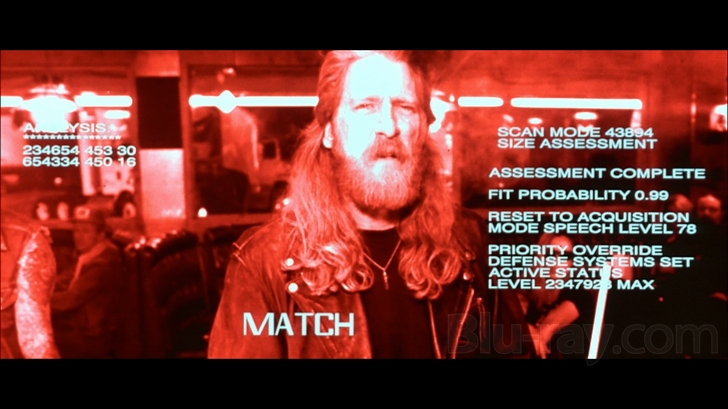
In the movie, Terminator II,  the opening scene shows the naked terminator walking into a bar looking for clothes. The majority of the scene is filmed as "through the eyes" of the terminator, and as the terminator strolls the room, data from numerous automatic subroutines is shown presenting itself onto its awareness .


Years ago, I was walking down a street with my family, in the Brooklyn district of New York, on my way to the subway museum. My wife and I were talking to each other trying to follow the directions on a map when suddenly an uneasy feeling came upon me. It slowly dawned upon me that lots of eyes were staring at us, and soon the realisation occurred that we were the only White people in a neighborhood where everyone else seemed Black.  While most people were on their way doing their usual things, there were definitely eyes of contempt directed at us.  Almost as soon as I became aware of our situation, my wife seemed to have become aware of it as well. An uneasy came upon us. Given that we had the children in tow, and the Subway was only about 300 meters away, we agreed that it would be better to nonchalantly cross the street and get back to the subway. We got there without incident. I imagine everyone has a similar story.

What was interesting about this situation, is that that the sense of threat posed to my family--assessed either rightly or wrongly--was first appreciated by an unconscious processing of the environmental situation and which eventually asserted itself onto my consciousness.  Clearly, what had happened whilst my wife and I were walking down the street, talking about our day's plan, was that visual information from my immediate environment was being assessed by subconscious subroutines and a a threat analysis was being made, all without any deliberate awareness by myself. Eventually, the subroutine felt that action was required and impressed itself on my consciousness by eliciting a sense of unease.

Now the traditional approach to western anthropology divided man into rational and irrational, or more specifically, biological and cognitive but what's become increasingly apparent is that this anthropology is wrong, and division should be made along the lines of biological, biocomputive and cognitive elements. With the biocomputive layer being able to process information for the majority of time without our conscious awareness of it, only making itself noticed through the sensations of intuition, attention, attraction and repulsion.

If you think about a simple task such as walking, you'll realise just how complicated a task it is to accomplish in real life. Neurons must fire to increase the tension in some muscles and decrease them in others, balance must be maintained, objects avoided , speed maintained and so on. If these actions were the result of a conscious deliberative process they would overwhelm the mind, instead subconscious subroutines take care of all the work and walking simply becomes an issue of command. Robotics engineers looking at the problem have termed it Moravec's Paradox.
The main lesson of thirty-five years of AI research is that the hard problems are easy and the easy problems are hard. The mental abilities of a four-year-old that we take for granted – recognizing a face, lifting a pencil, walking across a room, answering a question – in fact solve some of the hardest engineering problems ever conceived... As the new generation of intelligent devices appears, it will be the stock analysts and petrochemical engineers and parole board members who are in danger of being replaced by machines. The gardeners, receptionists, and cooks are secure in their jobs for decades to come.

and;

Encoded in the large, highly evolved sensory and motor portions of the human brain is a billion years of experience about the nature of the world and how to survive in it. The deliberate process we call reasoning is, I believe, the thinnest veneer of human thought, effective only because it is supported by this much older and much more powerful, though usually unconscious, sensorimotor knowledge[Ed]. We are all prodigious olympians in perceptual and motor areas, so good that we make the difficult look easy. Abstract thought, though, is a new trick, perhaps less than 100 thousand years old. We have not yet mastered it. It is not all that intrinsically difficult; it just seems so when we do it.
Our conscious rationality rests upon a deep foundation of biocomputative processing of which were are largely unaware of. Now, most people instinctively grasp the fact that biologically automatic processes are involved in motor movements, but what needs to be recongised is that automatic processes are also involved in our perception and cognition which result in unconscious biases in our thinking. The influence of these biases are most marked at the level of System 1 thinking, in other words the thinking of the cognitive miser: the average man. These biases are not bugs but are features of the system, designed to ensure our long term biological survival in a primitive environment.  For instance, the preference for blue, amongst Europeans may be "hard coded" in our DNA as a result of evolutionary--or whatever else--selection. It's not a learned behaviour.

The point of all this is for people to recognise that we are inbuilt with biases and preferences which are not deliberately chosen but which are "hard wired" into our biocomputative architecture. Sometimes our preferences are not a choice, but are a feature of our innate biology and therefore intrinsic to what it means to be human.  Stereotyping, color association and  homophily are examples of human biases which may provide a foundation for thinking about human relations in a way which avoids the pernicious affects of Darwinianism which has so plagued the Right in the 20th Century.

For those who are interested in scientific papers.

Link 1.
Link 2.
Link 3.
Link 4.
Link 5.
Link 6.

Wednesday, February 17, 2016

Rethinking Race and Identity:II

In the history of attempts to discover the causes of human behavior, the most widespread explanations are based on the assumption that human beings do what they believe is good for them. Thus, they are construed as “rational animals” capable of recognizing the value or utility of their actions.

At the same time, however, it is obvious that human beings do not always act this way; that is, under certain circumstances people behave in ways that do not reflect their values. To account for this phenomenon, to which the Greek philosophers gave the name akrasia (e.g., Mele, 1992), several strategies have been pursued. The first strategy assumes ignorance or lack of knowledge on the part of the actor. Socrates, for example, claimed that if people only knew what is good for them, they would act accordingly.


 A similar position is held by modern economists who imply that irrational decisions reflect a lack of appropriate information (Friedman, 1976). The second strategy postulates more than one set of principles that may control human action. For example, a behaviors may occur mindlessly (Langer, Blank,& Chanowitz, 1978) or automatically; that is, without directing much attention to the utility of an outcome, a person may act the way he or she has acted many times before. Such habitual behaviors were the focus of many psychological theories in which the frequency and recency of previous executions of a given behaviour were seen as primary determinants (e.g., Hull, 1943). The third strategy has been to understand human behavior as a function of drives. In particular, basic needs that are biologically rooted, such as hunger, thirst, or  reproduction, are seen as major forces. Their strength may override considerations of utility and determine behavior in an immediate fashion.

I think one of the great "fault lines" in Western Civilisation finds its origin in the Aristotlean influence upon Western Anthropology.  This view held that what distinguishes the man from the beast is his capacity to rationalise.  Furthermore, a dividing line was drawn between rationality and it's opposite, irrationality. But what's become apparent in a growing body of cognitive science research is that there appears to be an arational layer of high order neural processing which profoundly influences our rationality, and it's the failure to recognise this cognitive process which has been the cause of much grief.

Roughly analogous to Freud's idea of the id, the arational mind is the unconscious level of information processing, which, in essence, constitutes the brain's operating system. If you think about it for a moment, before you can "see" anything. Visual stimuli from the eyes have broken down into components such as movement, form, colour, texture and pattern, all of which happens without any rational activity on the behalf of the agent. Or take walking for instance, it's a pretty much automatic activity, with next to minimal conscious input, yet the decision to move forward, needs to be interpreted and broken down into a co-ordinated series of neurological and muscular actions in order to propel oneself efficiently without falling over.

Or sexual arousal? Why does the obese woman elicit a sense of repulsion whilst and nubile one a sense of desire? The sensation of desire isn't as a result of a rational deliberation, rather the unconscious mind takes visual data, processes it, evaluates it against some predetermined erotic metrics and then elicits the appropriate response. All of which, except for the sense of desire, occurring at an unconscious level. The sexual response isn't an example of rationality, its an example of arationality. The processing of information is automatic and without conscious deliberation.

The thing about the arational mind is that its operation seem to be hardwired, or biased, toward certain outcomes and behaviours and its the nature of these biases which give us the peculiarities of our human nature. Our mind is biased to prefer the beautiful to the ugly, to nubile to obese, sweet to bitter, nonthreatening to threatening, ingroup to outgroup, and so on.  And it is these biases which express themselves onto our thoughts and it's there where we can chose to act on them in a rational or irrational manner.  The important thing to recognise is that these biases operate, by and large, unconsciously.

The other thing to note, is that high order human rationality is not present at birth but rather develops and begins to mature--for some--in adulthood. Therefore, it is in early childhood, given the immaturity of rational thought, that our subconscious "software" is visible in its most undiluted form.

It's difficult to fully appreciate the fact that understanding and interpretation of novel phenomena is made within the framework of previous assumptions of how the world works. The great breakthroughs in science being more a re-evaluation of the assumptions rather than any novel data. Einstein's theory of relativity was more than just an explanation of data results, rather it was a profound shift in our understanding of how the universe works. Likewise, the current revolution in cognitive neurosciences forces a re-evaluation of our notions of cognitive anthropology.

Which brings me to the purpose of the previous post which whose purpose was to illustrate the famous Clarke Doll experiment. For those who are interested, the experiment has been repeated many times with similar results. Faced with the experimental data, the problem for the psychologists performing the test was how to explain the the preference of both Black and White children for light coloured dolls. It' easy enough to claim that the interpretation of the result--i.e that it was a product of racism--was the result of Left wing bias, but the problem is; How do you interpret the findings when your operating model of human cognition--due to the Aristotlean legacy--only admits irrationality or rationality?

If you assume that the kids start off as "blank slates," and that the kids are rational, your only logical interpretation of the experiment is that the results are learned. i.e. Children are taught to be discriminatory.  There needs to be no left wing bias in order to interpret the result along those lines and science supports the Left.

I don't think people fully appreciate how much "blank slatism" and the rationality/irrationally dichotomy has facilitated the mass social engineering experiments of the late 19th and early 20th Century. The fundamental notion at play here is that human behaviour is all learned and none is innate, and therefore humans are capable of near infinite plasticity. In this framework, racism, like every other form  of behaviour is learned and itt's this philosophical assumption which has underpinned all the social engineering experiments of the 20th Century and its a legacy which we, in many ways, owe to Aristotle and Plato.

Back to the Doll experiment. When researchers repeated the experiment in a remote Japanese village with little contact with both blacks and whites the results there were the same.
First and foremost, Study 2 revealed the presence of early implicit and explicit race bias in our Japanese sample. These biases were robust at the earliest age tested, and were of similar magnitude to the biases exhibited by White American children. Thus, early race bias does not appear to be highly dependent on contact or exposure to outgroup members [ED]. This finding supports the notion, suggested by Study 1, that younger children’s race bias may be a general response to group-level difference, rather than a focused response to a specific outgroup.
In other words the observed behaviour is not learned, i.e institutional racism, rather, the discriminatory behaviour is innate.  (Hence the liberal mother's shock at the white childs KKK like behaviour her child in the previous video, she did not teach her child to be racist.) However, a good review of "child racism" literature shows that the concept of "race" awareness seems to only arise in late childhood. So what's going on?

What appears to be happening is, given the relative lack of development of higher cognition in children, children seem to be making their evaluations based upon innate arational subroutines which they are born with. Colour being one of the most primitive and earliest utilised method of differentiation. The "forced choice" nature of the Clark Doll experiment is forcing children to make a choice based upon pre-wired color associations and colour biases. In other words, the test is not a test about racism but a colour association test.. When forced, in an area of information ambiguity to choose, for children, color provides a cue for a response.  And the the dark=bad, light= good is an innate response seen in children and adults. Link 2: The response is arational and innate.

The point of this is that many behaviours that humans exhibit aren't necessary rational but may be consequence of arational behaviours and biases which have their origin in the genetic code. We discriminate between individuals not because of any rational reason but because our "hardware" does it automatically.

Monday, February 08, 2016

Rethinking Race and Identity: The Doll Experiment.

It's late in the evening and I'm tired, so instead of this being a long argued post, I thought I put up two videos which will be the topic of my next post. 

 
and this video.


Saturday, January 30, 2016

Cleaning Out the Closet. II

 
Politically, the most interesting thing that has happened to the Right has been the growth of its dissident faction, the Dissident Right(DR), a faction disgusted with what passes as the mainstream or institutional Right.  This dissident faction can be thought of as the overriding name for all the separate Right groups that are opposed to the current conservative status quo.  It's  not a unified force rather it's a collection of disparate groups that can be broadly categorised on how they approach the problems of politics and philosophy. As mentioned in my previous post the Dissident Right can be broadly divided into the "feeling Right" which is typified by the Alt-Right and the "thinking" Right which, I feel, is typified by Neoreaction.

Neoreaction, by its very nature, is an intellectual exercise  and therefore is always going to be a minority position. As Stanovich and cognitive science have previously demonstrated, the majority of men are "feels"  rather than "thought" driven. The Alt-Right, as mentioned in the previous post, is primarily a "feels" driven phenomenon and as the dissident right grows in numbers it is to be expected that the feels component will assume a greater significance. This is a problem.

Unfortunately, "feels driven solutions" are typical mob solutions, which tend to be violent,self-destructive and self-corrosive. Fascism (in all its variants) was a "feels" driven response to the problems of the early 20th Century and we all know how that ended up. The problem with the entryist invasion of the dissident right is that they are going to exert an influence on it simply by virtue of their mass, the task at hand is how to stop the mob from going stupid. This I feel is the role for NRx.

What distinguishes NRx from the Alt-Right is concern for the facts. The Alt-Right has no need for facts, it wants to embrace the myths, to be on the side of the God's  and, in that way, resembles some of the worst aspects of the Left (who were on the side of the Angels in Vietnam, for instance.) For Neoreaction, empirical observations matter and NRx forms its opinions and insights from the due consideration of the them.The critique of universal democracy, for instance, is not grounded in a "preference" or bias for for other systems of government, or the myth of aristocracy, rather it comes from a considered understanding, based upon the empirical observations of the "average voter". If Neoreaction had a motto, it would be Solzhenitsyn's, "Live not by lies".

What unites all of NRx, in my opinion, is a concern for the Truth. We may quibble on points of the truth but real problem is in what  divides NRx, and that is the scope of the truth.  I don't think many in NRx fully appreciate that contemporary NRx has a very deep metaphysical problem, which is best explained by the fact that NRx can itself be divided into two groups: Positivist (+) NRx and Non-Positivist (-)NRx. 

Positivist NRx is most typified by the Moldbuggian strain of NRx.  This issue at stake here is the understanding of Truth and Reality. In +NRx what is considered a valid truth is defined within the positivist metaphysic, a metaphysic which is shared by both the Left and +NRx . +NRx is therefore, simply, an intellectually honest, and better form, of Positivism

It needs to be understood that the Left is, in many ways, cognitively like the Alt-Right. It's largest contingent, the mainstream Left, is a culture which subordinates fact to myth,i.e the myth of radical equality, with "the feels" being the overriding imperative. However, there are a very few serious thinkers amongst the more intelligent Left, and the prevailing metaphysical system in which they operate is Positivistic.  The serious Left have always had an ambivalent attitude towards the truth, being willing to subordinate it for a greater cause, but where truth is admitted it is always done within the framework of Positivism. Therefore what distinguishes the a left positivist from a NRx positivist is the willingness to be believe in dishonest propositions.

Therefore we can define Leftism as;

(dishonest) Positivism in error = Leftism

However, and this is the kicker, error does not always have to be deliberate, sometimes its unintentional. Thinking is hard, reasoning is flawed, frequently biased and honest mistakes are made. The logic however is inescapable;

(honest) Positivism in error  = ? (hint, look above.)

See the problem?

What separates the two is malice not epistemology.

If you think about it a bit you get a bit of shudder when you realise that Moldbug is an unwitting plant.

Now, there's error and there's error. Errors in the physical sciences are unlikely to affect societal stability, errors in the our understanding of how humans interact are liable to be civilisation destroying.  Things like sexual morality may have a more profound effect on societal stability than, say, how you arrange the political governance of a country. The point being, that you have to have the capacity and intellect to see the toxicity, if you're an +NRx who can't see it, your societal prescriptions will mirror the Left, in either of its Marxist or Fascist variants when it comes to such matters.

Good quality +NRx thinkers will make few mistakes and therefore have a better grasp on reality but the "honest", poorer thinkers are the epistemological equivalents of Leftists. No matter how good any +NRx thinker is, he is still stuck within the confines of Positivism and when +NRx goes "bad" it goes Left. +NRx is unable to escape Modernism/Leftism because their underlying metaphysics are its foundations.  They are stuck in the Left Matrix and there is no way out.

The great divide between the past and modern world lay in our understanding of reality, Positivism was a reduction in recognition of the scope of it. The pre-moderns, and most of the world bar the West,  holds the view that there is more to reality than can actually be "accessed" by our biological senses. Religion was the principal access path to these other verities and hence the importance of it in non-Positivist societies. Non-Positivist NRx, (-NRx) takes religion into account by explicitly rejecting the implicit limitations of Positivism and views religious insight as akin to empirical data.  As mentioned in a long previous post, Faith is a sensory modality.

Relgious faith, particularly the religious faith of the West serves therefore as another dimension of information in the analytic of -NRx. -NRx doesn't reject  the empiricism of Positivism, rather it sees its data set as incomplete. -NRx needs to be thought of not as anti-positivist, rather it is supra-Positivist. Science still matters, but so does the "faith" data. In -NRx there is NO conflict between faith data and empirical data, rather, reason aims to find a reconciliation with both since the truth is a singularity, incapable of contradiction.

It needs to be understood that Positivism's unrelenting march throughout the late 19th and early 20th Century came about because it was the first to consistently apply the principle of the primacy of empirical data over theory, despite its simultaneous reduction of the scope of it. It insisted on reason being "calibrated" to real world findings. Tradition and custom were unable to achieve this calibration and thus were pushed aside as Positivism "delivered the goods" in the form of technological progress. The tragedy of the 20th Century has come about because traditionalism was unable to deal with Positivistic success.

-NRx takes the principal of the primacy of empirical data over theory and incorporates it into a wider data set.  -NRx is a sort of fusion between traditional concepts of the scope of empirical data with the positivist insistence on the primacy of data. It's a fusion product. This, however, puts -NRx explicitly against traditionalism, insofar as traditionalists elevate custom above the truth. This, itself is not a bad thing, given traditionalism's utter failure to combat the Left. New approaches need to be tried.

I personally don't think any political program on its own is going to work. What is needed is a spiritual renewal of the West but the traditional spiritual "institutions" have proved themselves unable to face the challenge of modernism. It is my hope that -NRx will act upon these institutions to instill a "bottom up" renewal of Western society, instead of a "top down" Franco like solution which has failed in the long run. Politics matters as well, but the primary task now is to reform the religious institutions of the West, still  I feel -NRx has a role in stopping the "feels" right from drifting and becoming too crazy.

The pathogen that is eating away at the institutions of the West is not a lack of scientific knowledge but moral decay.  Intelligent but corrupt officials destroy the efficiency of government, Hi IQ cads and whores destroy the institution of the family, Journalists lie, Doctors murder, Judges administer social justice instead of law, and everyone lies. That's why any revival of the West will primarily consist of a moral revival and not a technological solution. The excluded data set must be incorporated else there is no way out.

Wednesday, January 27, 2016

Cleaning out the Closet: I

I think 2015 will be seen as a watershed year for the Right. As mentioned in my previous posts, it was a year of mixed blessing and I thought I would try to take stock of the situation as now it stands now in what I would call the Dissident Right. I think it is important to distinguish between the Alt-Right and NRx since the two are different yet people seem to use the terminology interchangeably at times. The Dissident Right (DR) can be thought of as comprising of both NRx and the Alt-Right who are united, at least, in a rejection of what constitutes the post war Institutional Right(IR) . 

Now, by DR, I mean the Right that has abandoned the post war conservative institutional consensus, in other words, what counts for "mainstream Conservatism" which is currently in its death throes iacross the Western World. The recent National Review edition against Trump is an example of the conservative consensus flailing about to keep the traditional constituency in tow. There seems to be global revolt of the rank and file against the institutional conservative establishment which increasingly fails to meaningfully distinguish itself from the Left. Furthermore, I think we've reached a sociological tipping point, in that extent of foreign migration (and its media coverage) has finally started to fuel a nativist backlash and, more importantly, the economic forces of globalisation have finally started to seriously impact upon the middle class.  Globalisation, whilst it was putting out blue collar workers was not a really issue for the Right but now that its pernicious effects are being felt in Middle Class--(politically the class that matters most)--a serious revolt has begun to brew.

It is these rebels from institutional conservatism which I call the Dissident Right. Now, the DR needs to be understood as comprising of two main streams;

1) The "feeling" Right and,
2) The "thinking" Right.

The "feeling Right" is pretty much owned by the Alt-Right, by which I mean the Radix like crowd.  This group "intuits" its political position and its rejection of the IR is more a case of the "feels" rather than the "thinks". It's essentially a romantic movement. In Richard Spencer's Political Theology, myth is more important than fact. The reason this is because any factual analysis of the "White" situation leads to uncomfortable truths. Truths which stymie the "racial awareness" renewal.  In brief, the White goyim are bringing the misery down, on themselves by themselves. It needs to be pointed out that the SJW's who are currently pushing for more "diversity" are nearly all white white. Attribution of decline to external groups such as the Jews, whilst having some plausibility, are unfounded so in the end, any sustaining principle must be rooted in an intuitive myth rather than a cold hard fact.

This however is a political winner, at least in a democracy. As Sam Francis in his brilliant, From Household to Nation, observed, the average middle class person was nothing more than an affluent proletarian and therefore far more likely to be motivated by the "feels" rather than the facts. His essay is basically a statement on the importance, in a Democracy, of personal circumstances over ideology and he attributes the failure of the IR to the neglect of this fact.  What has driven the shift to the DR, in particular the Alt-Right is, that over the past decade, the circmstances of the middle class have started to decline with a subsequent rise in middle class anxiety. The Alt-Right caters for this anxiety in a way that the sheeple can grasp. It doesn't argue rationally it persuades emotively.

Years ago, the mainstream media control of information would pretty much shut down any legitimate access to the Alt-right, but given the internet, that control has been lost and groups such as Radix have been able to package themselves--somewhat--as identitarians and not as Nazi's who are able to slickly articulate the problems of the middle class. Furthermore, by providing "low brow" intuitive solutions to problems, their appeal is slowly growing and it is this segment, because of its socio-intellectual nature, has provided for the most explosive growth in the Dissident Right.

The other area where it owns the field is in the ideology of identity. Make no mistake, there is a crisis of national identity going on throughout the Western World, bough about by multiculturalism, which is being suppressed by political correctness yet which yearns to find expression and is yet another reason for the growth of the DR.  Other conservative movements simply do not come even come close to providing for coherent solutions to the problem, however its mistake is in placing the foundation of identity in biological race--with all of its Darwinian baggage and repulsive evolutionary "solutions"--instead of grounding identity in the natural biases of human nature. 

But make no mistake, the Alt-Right is still a "mass-man" movement and therefore is a spiritual heir of the French Revolution. It is anti-NRx. It's a democracy/socialism/authoritarian system where the franchise is based on color. And therefore, it brings with it all the problems to culture and society that democratic Mass-man society brings. Many forget that it was "white" democracy that bought us this current civilisational mess. Furthermore, no matter how you cut it, given its nationalist, identitarian and racial emphasis, it's intellectual underpinnings are shared with the Fascist movement. Now contrary to popular belief, Fascism was a broad "Church" ranging from the mildness of the Action Francaise to the murderous Nazi and Ustashe regimes. I'm not at all suggesting that Alt-Right are Nazi's but it needs to be remembered that even though all not all  fascists are Nazi's all Nazi's are fascists. All variants of Fascism share the same metaphyisics and what distinguishes them is in their different approaches to real world "solutions" to problems. Given this common metaphysic, the Alt-Right is a home where Identitarians and National Socialists can find common cause. As I see it, there is no corrective mechanism in the Alt-Right movement to prevent a virulent natsoc capture of it. Should this happen the movement would self destruct and drag any other associated movements down with it.

I'll deal with the "thinking" Right in my next post.