Showing posts with label Sex. Show all posts

Wednesday, March 12, 2014

Phenotyped.


As mentioned in my previous post, one of the facilitators for the rise of feminism and separation of sex and gender has been the predominance of Dualistic understanding of the human person.  Feminism and all the other variants of gender aberration draw their strength from this predominant Western understanding of man and thus any Christian push-back to these movements  must avoid a purely "spiritual" approach to the problem. Calls for more prayer, reflection, virtue on their own, will make matters first by unintentionally re-enforcing the Cartesian duality. The work around to this problem is by balancing the spiritual perfection of man with an insistence on his physical perfection as well. Effectively, what is needed is a muscular Christianity.

Literally Muscular.

If Christians are to be serious with regard to pushing back Cartesian dualism they need to reassert the hylomorphic model. They need to balance the prevailing culture by affirming the goodness of the flesh since according to hylomorphism bodily perfection is but is one measure of spiritual well being.

To illustrate what I mean, consider the following example. A house is an arrangement of building materials according to a plan. It's hylomorphic in the sense that the plan determines the arrangement of the material. Now, assuming that the plan is good, the goodness or the badness of the house is dependent upon how faithfully the material is arranged to the plan. A good house reproduces the plans perfectly, a bad house is one that is deficient in some way, say, in workmanship or quality of materials.

On the other hand, the materials and workmanship may be good but the plan is flawed. For example a house that is designed in such a way so that it is almost guaranteed to leak (see Frank Llyod Wright) is a bad house. It's bad because it doesn't conform with our pre-conceived conceptions of what constitutes a good house. Therefore a house may be defiecient in either workmanship, materials or design.

Keep this thought.

Now biological sex needs to be seen as the physical instantiation of gender, or in other words, the "plan" of the human being.  A man is the biological instantiation of the masculine form whilst a female is the instantiation of the feminine. Masculinity and femininity are therefore not something "tacked on" to the body but rather physical states of human being. It also needs to be understood that masculinity and femininity don't just code for the sex organs but their imprint is felt at the level of biochemical processing, neurological wiring, skeletal structure, muscular placement etc. Gender permeates the entire human being and so the dichotomy between gender and sex is false. Gender and sex are one.

A perfect woman, for instance, is one that perfectly instantiates the feminine ideal. Her body will be perfectly feminine. She will think in a feminine way, walk in a feminine way, talk in a feminine way and so on. Femininity permeates here entire being in both presentation and act.

Now, masculinity and femininity need to be seen to be seen as akin to "house plans" the proper expression of the plan may be frustrated by disease, mutilation or neglect. Shoddy workmanship or material may impinge upon the expression of gender and therefore gender deficiency needs to be seen as a privation of instantiated form. The interesting thing here is that this privation of gender assumes a moral dimension when it is deliberately chosen. In other words, deliberately making yourself less masculine or feminine, either through neglect or by choice, is an evil. Caritas imposes a moral duty to stay true to our gender type.

But how do we determine what constitute perfection in form when it comes to gender? The feminists could quite literally argue that we are simply defining form according our own conceptions of it and therefore there is no such thing as "objective form".

The feminists have a point, in that our conceptions of gender have a certain degree of subjectivity to them. But the accuracy of our subjectivity is one of degree and not of direction. In this famous image, which is a morphed average of the faces rated on "Hot or Not"
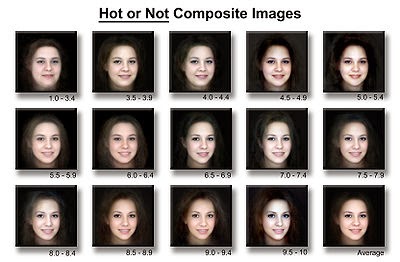
 there is a clear variation in facial morphology between the least rated and the most.  Something which would not be present unless there was some type of predetermined human response to facial beauty.* In nearly all higher order civilisations, there appears to be an extraordinary degree of congruity with regard to conceptions of masculine and feminine beauty which leads to the conclusion that there must be some kind of genetic basis to our response to beauty.* There is a certain degree of objectivity to the issue.

What is masculine or feminine, therefore, is not determined by philosophical argument, or social construct, or power relationships, but by our human response to the experience of it.What's masculine is that which is what we feel to be masculine and likewise for femininity. The summed human experience of them are therefore accurate guides to their essential natures.

The reason why we find the fat, weak, deformed or disfigured unattractive is because our biology elicits a noxious response to their presence. Our biology therefore has a strong influence with regard to our determination of  physical beauty and we are hard wired to be drawn to the beautiful. (i.e. that which has a perfect form)

But the other dimension which strongly influences our conceptions of gender polarity is that of the erotic. Now by erotic, I mean the whole series of qualities in a person of the opposite sex which draws us to them. When the average man argues that his ideal woman is combination of a Madonna, a mother and a whore he is crudely outlining his conceptions of an ideal femininity across its many dimensions. Gender polarity, in fact is most marked when considered from an erotic perspective and what's interesting when you look at it from this approach is that evaluations of masculinity and femininity are to a large degree determined by the opposite sex. What the opposite sex finds sexually attractive is what is sexually attractive. Therefore masculinity can be objectively evaluated at this level by observing the response of women to different types of men. Conceptions of masculinity/femininity which ignore this dimension are thus false and it is precisely at this level where traditional carnal-lite approach to Eros has done most harm. The war against Eros has diminished gender polarity and has facilitated the rise of androgyny.

The hylomorphic critique of feminism therefore is on two levels:
  1. Firstly Hylomorphism is opposed to Cartesian (body-spirit) approach in its understanding of the human sexuality. Sex and gender are not distinct entities but rather a intertwined physical instantiation of one.
  2. The hylomophic approach criticises feminism because it is an ideology which embraces the privation of the feminine form. It makes women literally unfeminine. It uglifies them.
The hylomorphic critique has nothing really to say on the legal status of gender except insofar as any law or legal privilege leads to a privation of form.  i.e. legislating women to be combat soldiers.
Here the critique is not that woman cannot perform the duty but rather that duty "defeminises" her and thus makes her less of a woman even though she may be a good combat soldier.

The Christian approach to feminists is thus to call them out as being less womanly than they should be. The problem with feminism and genderism of any kind, is not that it turns them into the opposite sex, it turns them into deficient human beings.

*Roissy's running a female attractiveness survey. The congruity of the ratings are proof of the relative objectivity when it comes to assessments of female beauty.

*Neoreaction needs to embrace bio-aesthetics in order to combat the crappiness of modern art and architecture.


Saturday, March 08, 2014

Cartesian Gender

Atheist warning. This is a socio-theological post.

Next, reacquaint yourself with the principle of hylomorphism.

Proceed.

One of the main contentions of this blog is that rise of modernism is a consequence of certain "structural" weaknesses  that were present in traditional society and culture.  Any conservative attempt to combat modernism therefore requires an understanding of the underlying pathologies which both gave birth to it and sustain it. I critique the Church quite a bit, not because of any malice, but because its ideas were the dominant cultural force which shaped the mindset of modern Western man and many modernist heresies are themselves mutations or adaptations of Christian thought.

As I've mentioned before, one of the areas of structural weakness concerned issues with regard to sexuality. The Catholic Church, at least in theory, has always endorsed a hylomorphic concept of man but in its war against the excesses of the flesh, the Church pushed back too hard and created a "carnal lite" version of man. This notion of man, comprised of a "good" spirit which led him to heaven and corrupting flesh which was dragging him to hell. And although the Church was officially committed to the hylomorphic vision, practically, in its day to day operations  it practiced a Cartesian duality with regard to the man's nature.  It's this Cartesian framework which sets up both the division of not only spirit and the flesh, but with a little imagination, of both gender and biological sex.

If identity and reason find their locus in the spirit, and the flesh is considered not only as something transient and temporary but hostile to spiritual perfection, it's easy to see how, when it comes to conceptions of the human person, the body is percieved to be both inferior to the spirit and hostile to it. Spiritual identity and corporeal body are thus put in opposition and though the Church did not subscribe to the dualist doctrine the take home message as understood by the faithful was Cartesian. It didn't help that the  Church in in its traditions, pushed the idealisation of the ascetic and the mortification of the flesh.  Modernism's conception of the human person is therefore an adaptation of mainstream Christian practice which saw rationality and corporeality as two separate entities.

Even Christianity's conceptions of masculinity and femininity tended to be framed along virtue centric lines and less along biological properties. To be manly, men had to possess virtues A, B, C......and so on. Women likewise had to posses virtues X, Y, Z....e.t.c. But the thing about virtues is that they are chosen behaviour: habits of deliberate choice which are not constrained by biology. When you frame gender along these lines you imply that gender is a matter of proper will and not biological nature. It's not much of a stretch to see how feminism gets its ideas of gender being both  a choice and social construct.

To illustrate what I mean, consider the following two women. Which of these is more feminine?


Now I've chosen Megan Fox for no particular reason except that she is very attractive but otherwise  morally average. Mother Teresa, on the other hand, is a moral giant but quite frankly is less attractive that Ms Fox.  How do we evaluate femininity in these two women?

There are strong strains in mainstream Christian thought which would assert that Mother Teresa is the more feminine of the two.  According to this approach, true femininity just as easily found in the obese-hirsute-fishmonger's wife as is in the Victoria's Secret model provided they live a Christian life. Likewise, traditional conceptions of masculinity tended to see masculinity as a series of character virtues. The problem with this approach is that it views femininity/masculinity as a collection of chosen moral qualities irrespective of the biological vehicle in which they are found. Thus, the Church's own position on the subject, while opposed to radical feminism,  provides unintentional support for its opponents by reinforcing in practice an underlying meta-philosophy that biology and gender are distinct. Feminist gender theory is a corruption of Christian Cartesian dualism.

On the other hand, Joe average, would clearly call Megan Fox the more feminine.  Because, for the average man, femininity is a metric of female perfection, not of moral quality and Ms Fox more closely approximates the ideal female form than Mother Theresa does. It strange to contemplate that the lecher honours hylomorphism in his sin more than the Church does in its practice, but the Devil is found where you least expect him and he's hardest to see when cloaked in apparent virtue.

The contemporary Christian problem, in its battle against gender/sex incongruity is how to fuse the two. The traditional cultural heritage, with its practical de-facto dualism, doesn't help since it effectively shares the same understanding of the human person as feminism does.  Pushing one helps the other.  Modern appeals of gender "authenticity" to biological sex are unconvincing. What exactly does "authentic" to self mean? Who defines it? The argument of every trans-sexual arguing for sex change surgery is that their bodies are not authentic to their nature's. The Christian response is that a trans-sexual's conception of their authenticity is not really authentic. It's a circular logic.

The workaround for this problem starts with a re-commitment, both in theory and practice to the doctrine of hylomorphism. Secondly, there needs to be a recognition that biological sex is the hylomorphic incarnation of gender. Thus gender is not a choice but a per-determined state of being. Thirdly, there needs to be an understanding that there may be "privations of form" with regard to gender incarnation and thus people may be born male or female and that they may be born with less than their fair share of masculinity or femininity. Fourthly, the operation of Caritas on the form of gender is to perfect it. Gender commitment is a virtue. Thus, anything which privates gender in any way, shape or form needs to be seen as an evil. Finally, the Church needs to recognise that moral virtue and gender identity are two separate things it needs to stop conflating the two. Just as a white man does not become more white by the practice of Charity neither does he become more manly by doing so. Virtue and gender are not synonymous.

Sunday, September 22, 2013

The Teleology of Coitus.

Note to the Atheists. Advance warning. This is a religious post.


Of all the encyclicals issued by the Church in the Twentieth Century Humanae Vitae was probably the most controversial. From the moment of its promulgation it was immediately met with opposition and controversy. Sociologically, it seems to have split the faithful and adherence to it is teaching being a litmus test of orthodoxy.

The other impression I've gotten from my years of looking at the issue is that while the Church's hierarchy is convinced of the documents "rightness", there does seem to be quite a lot of private consternation at the effect it has produced. There almost seems to be desire for some type of solution to be found.  People felt that if only the document could be be "better explained' then the faithful would be drawn back to the fold.

I think this why JP II pushed the phenomenological approach, especially when it came to "contraceptive" matters. Now, maybe because of my retardedness, I've never understood the phenomenological argument against contraceptive sex. The idea that the contraceptive sex was a typed of "reservedness" when it came to love could as just as equally be applied to sex deliberately chosen when a woman is infertile. i.e. NFP. Choosing to have sex when a woman wasn't fully herself (i.e. fertile) could also be construed as a type of "rejection" of a woman's totality and a violation of "true" love.  The conflation of sex and love made it all a bit vague as well.

My own view of Humane Vitae, taking a Caritas approach, is that it is fundamentally correct. Any act which violates the telos of sex is a privation of the act and therefore intrinsically wrong. Just to be clear about this matter, this rubs me against my natural inclinations as well but the arguments are clear and convincing. As a servant to the truth I have to submit to them.

But whilst I think Humane Vitae was right in principle, I've had the growing conviction that it was wrong in what it considered contraceptive, much like the Church in the Middle Ages, which regarded all forms for interest bearing lending as usury--the Church may have banned too much.

The problem, I think, lays in the Church's understanding of the telos of sex, which it views as being intrinsically fecund. In other words, the sexual act, when non-privated in any way, shape or form is intrinsically fertile.  Or to put it another way, an infertile sexual act is one that is privated in some way, either voluntarily or involuntarily. To put it a third way, the perfect sexual act, considered in itself, always produces babies.

Now, this does not mean that the Church expected every sexual act to be fecund. It understood that privations of various kinds were beyond the control of sexual persons and therefore the sexual act was not illicit when performed under involuntarily privated conditions.(Though there was opposition to this notion) The Church never banned couples from sex whilst a woman was in menopause or after a hysterectomy. They key concept here, though, is that these though the participants in these sexual acts incurred no negative moral imputation, the acts themselves were considered privated and not teleologically complete. 

I imagine that this traditional understanding came about because of the primitive understanding of the physiological mechanisms of conception. The Ancients thought thought that the failure conceive following a sexual act was due to a "fault" in the system. Natural lawyers, drawing from animal analogies, determined that the "purpose" of sex was reproduction. Combined with an Augustinian view of sexuality, which saw the "fleshy desires" as corrupting, a view sexuality took hold which saw sex as only legitimate within the context of reproduction. Both veneration for tradition in the Church and its "anti-fleshy" tendencies meant that this view was very difficult to change.

So, it was interesting to see that conundrum that Catholic confessors were put in when the mechanism of ovulation began to become elucidated. Catholics, as they became aware of the fact that women were fertile only for a limited period in their cycle, began to start timing intercourse during the periods when a woman's fertility was least. This put confessors in a bind. The traditional teaching was that sex was for conception and therefore having sex simply for pleasure was morally dubious. According to Noonan, there was a wide range of opinions on the matter ranging from outright condemnation to qualified support of the practice.  Confessors, seeking advice, petitioned to the The Sacred Penitentiary who advised them to leave the faithful alone. The Church sat on the fence.

It was not until Castii Connubi that the Church officially declared that it was not sinful to deliberately have sex when a woman was not fertile. I don't think people really realise what a revolution in Church morals and repudiation of 'tradition" that this document represented. Still, the document saw sex as the "secondary" end of coitus and persisted with the notion that the sexual act was intrinsically fecund.

 Nor are those considered as acting against nature who in the married state use their right in the proper manner although on account of natural reasons either of time or of certain defects, new life cannot be brought forth. For in matrimony as well as in the use of the matrimonial rights there are also secondary ends, such as mutual aid, the cultivating of mutual love, and the quieting of concupiscence which husband and wife are not forbidden to consider so long as they are subordinated to the primary end and so long as the intrinsic nature of the act is preserved.

On deeper reflection, however, this view is problematic. A normal woman's menstrual cycle ensures that she alternates between periods of fertility and infertility, the question then needs to be asked: Is a sexual act performed during the infertile phase of a woman's cycle intrinsically privated in itself?

If we assume that God's intention can be revealed through our "design", then the period of fertility privation that occurs during the menstrual cycle would be a feature and not a bug of the system. In other words, did God intend sex to be infertile during a portion of a woman's menstrual cycle? Because, if he did, the telos of sex during this period is not fecundity because by its very nature the act is sterile by divine design. This is at odds with the Church's teaching. The only way you can square the circle between tradition and our understanding of physiology is to assume that the the infertile period of a woman's menstrual cycle is some sort of privation. But that of course leads to the conclusion that God deliberately produced a faulty product. (There's a whole host of theological problems with that.)

Given the coitus is possible during all stages of the menstrual cycle, what the design of the cycle reveals is that coitus can only achieve its telos of conception during a small portion of it. The rest of the time coitus is intrinsically infertile by design. It would appear that the telos of coitus varies with the stages of the menstrual cycle and the Church's insistence that the coitus is intrinsically orientated towards procreation would appear to be at odds with the findings of physiology.

A sexual act performed during this infertile period is meant to be intrinsically infecund by design. The problem with the idea that sexual activity achieves it telos when conception occurs would mean that woman is intrinsically privated during her infertile period. This would mean that God either deliberately designed a fault (mistake)in women or that he deliberately intended sex to be infertile during this period. i.e. a sexual act performed during the infertile period is teleologically complete and not ordered towards procreation.

Then again, there is the issue of menopause. Did God make a mistake? Is menopause a disease or a deliberate state intended by God? If it is intended by God, then intercourse during this period is teleologically complete and intrinsically not orientated towards children.

Then there is the issue of the suppression of ovulation by lactation. Now, this is either an intended or unintended feature of the mechanism. If unintended, it means God made a mistake: if intended, it means coitus is not intrinsically fecund during this period by design. On the other hand, if we assume that coitus is meant to be intrinsically fertile, then the deliberate use of this method to suppress ovulation--a method approved by the Church--is deliberately of malign intent since it aims to private a woman's fertility. The fact that the mechanism is endogenous in no way absolves it of its evil.

The idea that a coitus is meant to be be intrinsically fecund is not just a statement of morals but of physiology as well. It implies that that an infertile woman (either temporarily or permanently) is a privated one. Or, to put it another way,  the ideal, non-privated woman (with respect to traditional sexuality) is meant to be fertile all the time: something which our understanding of physiology refutes. The idea that sexual activity is meant to be intrinsically fecund is the "traditional" understanding of physiology being "front-loaded" into morals by Natural Law philosophy.*

FWIW, my own view on the teleology of coitus is that the coital act achieves it telos when sperm is deposited in the vagina. This approach squares up with all the physiological findings and does not result in us thinking of menopause as a disease or the infertile periods of the menstrual cycle as being some form of privatory state. It also squares up with a lot of traditional morality.

Finally a word about NFP. (Natural Family Planning)

Over at Zippy's blog there has been some criticism of the critics of NFP who tend to see similarity with the practitioners of NFP and contraceptors.

Now, an act's morality is determined by the act, the intentions and the circumstances. All it takes is for one of these elements to be morally wrong for the act to assume a negative moral character. If, for the moment, we push circumstances aside, we see that while the NFP crowd and contraceptors clearly act differently their intentions are the same.

If coitus is mean to be intrinsically fecund then the intention of both parties is to instantiate a privated form of it (the desire for the privation of a thing) is morally wrong. The idea that NFPer's are "open to life" is contradicted by the fact that they are timing coitus for periods when the capability of generating life is apparently non-existent. It's like saying you want to go to Church but then deliberately turn up when you know that Mass is not on. This type of cognitive dissonance is usually found amongst the idiotic left who say one thing and do another. The problem of intentionality is solved if the intention to pursue infecund sex as an end (through licit means) is seen as morally legitimate.

Note: Anyone who wants to comment should remember that post is about the telos of sex and not contraception.

*I'm doing exactly the same thing except that my understanding of the telos of sex comes from an updated understanding of the biology of it, not some Galean understanding of sexual physiology.