Friday, August 06, 2010
You Need to be Good Looking to Attract Hot Chicks.
BTW, when choosing a wife it's important to choose carefully.
Wednesday, August 04, 2010
What Conservatism Is.
Now the whole parable and purpose of these last pages, and indeed of all these pages, is this: to assert that we must instantly begin all over again, and begin at the other end. I begin with a little girl's hair. That I know is a good thing at any rate. Whatever else is evil, the pride of a good mother in the beauty of her daughter is good. It is one of those adamantine tendernesses which are the touchstones of every age and race. If other things are against it, other things must go down. If landlords and laws and sciences are against it, landlords and laws and sciences must go down. With the red hair of one she-urchin in the gutter I will set fire to all modern civilization. Because a girl should have long hair, she should have clean hair; because she should have clean hair, she should not have an unclean home: because she should not have an unclean home, she should have a free and leisured mother; because she should have a free mother, she should not have an usurious landlord; because there should not be an usurious landlord, there should be a redistribution of property; because there should be a redistribution of property, there shall be a revolution. That little urchin with the gold-red hair, whom I have just watched toddling past my house, she shall not be lopped and lamed and altered; her hair shall not be cut short like a convict's; no, all the kingdoms of the earth shall be hacked about and mutilated to suit her. She is the human and sacred image; all around her the social fabric shall sway and split and fall; the pillars of society shall be shaken, and the roofs of ages come rushing down, and not one hair of her head shall be harmed.
G.K. Chesterton was the perhaps the greatest modern apologist for Christianity. The levity of his writing frequently disguised the profundity of his thought. Chesterton realised that at the 19th Century that there were many social ills. Society at that time had serious problems which needed to be solved and traditional solutions did not work. He recognised that the "progressives" were willing to change society, but in the wrong direction, whilst the traditionalists at the time did not want to change society at all.
Chesterton recognised that before any social change should take place an understanding of life and things in general needed to be made:
Suppose that a great commotion arises in the street about something, let us say a lamp-post, which many influential persons desire to pull down. A grey-clad monk, who is the spirit of the Middle Ages, is approached upon the matter, and begins to say, in the arid manner of the Schoolmen, “Let us first of all consider, my brethren, the value of Light. If Light be in itself good–” At this point he is somewhat excusably knocked down. All the people make a rush for the lamp-post, the lamp-post is down in ten minutes, and they go about congratulating each other on their unmediaeval practicality. But as things go on they do not work out so easily. Some people have pulled the lamp-post down because they wanted the electric light; some because they wanted old iron; some because they wanted darkness, because their deeds were evil. Some thought it not enough of a lamp-post, some too much; some acted because they wanted to smash municipal machinery; some because they wanted to smash something. And there is war in the night, no man knowing whom he strikes. So, gradually and inevitably, to-day, to-morrow, or the next day, there comes back the conviction that the monk was right after all, and that all depends on what is the philosophy of Light. Only what we might have discussed under the gas-lamp, we now must discuss in the dark.
Chesterton realised we needed to understand the "truth" of the matter before we proceeded with societal change. While Chesterton respected tradition (the democracy of the dead) he respected truth more. The aim of man and society was to live "rightly" and with that implied the concept of right and wrong.
Therefore Conservatism is therefore the desire to live rightly, from which politics proceeds.Nothing more strangely indicates an enormous and silent evil of modern society than the extraordinary use which is made nowadays of the word "orthodox." In former days the heretic was proud of not being a heretic. It was the kingdoms of the world and the police and the judges who were heretics. He was orthodox. He had no pride in having rebelled against them; they had rebelled against him. The armies with their cruel security, the kings with their cold faces, the decorous processes of State, the reasonable processes of law--all these like sheep had gone astray. The man was proud of being orthodox, was proud of being right. If he stood alone in a howling wilderness he was more than a man; he was a church. He was the centre of the universe; it was round him that the stars swung. All the tortures torn out of forgotten hells could not make him admit that he was heretical. But a few modern phrases have made him boast of it. He says, with a conscious laugh, "I suppose I am very heretical," and looks round for applause. The word "heresy" not only means no longer being wrong; it practically means being clear-headed and courageous. The word "orthodoxy" not only no longer means being right; it practically means being wrong. All this can mean one thing, and one thing only. It means that people care less for whether they are philosophically right. For obviously a man ought to confess himself crazy before he confesses himself heretical. The Bohemian, with a red tie, ought to pique himself on his orthodoxy. The dynamiter, laying a bomb, ought to feel that, whatever else he is, at least he is orthodox.
As "ought" can't be derived from is ultimately questions of right or wrong are religious questions. Therefore the Conservative view is premised on three things.
1) The belief in religion
2) The belief in right and wrong.
3) The desire to live according to those beliefs.
Over at James Kalb's there is an interesting paper up for discussion, Traditionalism and the American Order, which asserts that the American Revolution was the first Liberal Revolution and from a traditionalist view point it is. The thing about traditionalism is, that a thing is liberal relative to the traditions you want to preserve. And if you're a European Monarchist, then the revolution was decidedly liberal, on the other hand if you're a traditionalist Marxist, it was a manifestation of bourgeoisie conservatism.
Chesterton would have had none of this rubbish. For Him, the founding fathers were convinced that they were doing God's work:
The American Constitution does resemble the Spanish Inquisition in this: that it is founded on a creed. America is the only nation in the world that is founded on creed. That creed is set forth with dogmatic and even theological lucidity in the Declaration of Independence; perhaps the only piece of practical politics that is also theoretical politics and also great literature. It enunciates that all men are equal in their claim to justice, that governments exist to give them that justice, and that their authority is for that reason just. It certainly does condemn anarchism. and it does also by inference condemn atheism, since it clearly names the Creator as the ultimate authority from whom these equal rights are derived. Nobody expects a modern political system to proceed logically in the application of such dogmas, and in the matter of God and Government it is naturally God whose claim is taken more lightly. The point is that there is a creed, if not about divine, at least about human things.It satisfies the test of Conservatism. It changed the world, but it changed it rightly.
Wednesday, July 28, 2010
What Conservatism Isn't.
Whilst browsing his blog I stumbled upon a piece by Michael Oakeshott entitled, "On Being Conservative". I had briefly skimmed upon some of Oakeshott's writings in the past but they failed to capture my imagination, but I put in the effort on this piece and sadly, it was wanting.
Oakeshott's contention is that Conservatism is a disposition, a resistance to change. Valuing things for the way things are and and as such not wanting to meddle with them. Basically Oakeshott's reiterates the view of the Progressives, that conservatives are people who unthinkingly resist change by virtue of their temperament. They are the treacle in societies progress; the dead weight inhibiting change. Timidity and anxiety their virtues.
Bullshit.
And this is all the more depressing that this opinion comes from a man who was professor of philosophy at the London School of Economics. If conservatism is "Intellectually light" its because of rubbish such as this.
Oakeshott's conservatism is by nature "value light", in that man can have a conservative disposition in all sorts of social political circumstances and by his definition called a conservative. According to Oakeshott's view, an elderly British colonel tending his roses and Russian bureaucrat in the Brezhnev Soviet union (a time when the communists were loathe to change anything) could both be considered " Conservative". Nazi's who resisted policy changes by the party could also be considered " Conservative". What matters is not what you believe in, but on how prepared you are to change. Stupid people, who take a long while grasping new Ideas could then be considered de-facto conservatives.
Who's side is he on?
Firstly and foremostly, Conservatism is not a disposition: it is a weltanschauung, a world view, a metaphysical system. Conservatism is not a resistive disposition, rather it is a metaphysical system which believes that there is a reality, truth or good which man bases his life on. Be that Shiva, Jesus, Allah, Science etc.
Conservatives of all stripes have ideas on what constitutes the good. And in the words of an Australian commercial, "When your on a good thing, stick to it". We don't resist change for the sake of it, rather change is resisted when thing are changed for the worse. And frankly over the last 100 years or so a lot of the social changes have not been for the best.
Conservative are right to resist change when it is from good to bad, but they're moronic if they resist change which is an improvement on the bad, something people disposed to reject change are liable to do. In a sick or corrupt society, it's the Conservatives which are the radicals agitating for change, wanting to change the way things are to the way things should be.
Sometimes I really despair.
Two Good Posts by Fred Reed.
Killing Feels So Good.
Hooking Up.
Enjoy.
Monday, July 26, 2010
Thoughts on the Attractiveness of European Women.
With regard to my scale, My tastes unfortunately tend to align with Roissy's with the exception that I prefer slightly older women. With that in mind:
Northern Italy:
Mean of 7 with standard deviation of 0.9.
I was pleasantly surprised. Not only were most of the younger women of normal to low BMI but they dressed in a way that was both feminine and not slutty.
Germany:
Mean of 5 with standard deviation of 1.2
The Aryan race needs some work. An abundance of fatties and no dress sense. Zero style but all in all a cheery bunch. Most are unfeminine.
Switzerland:
Mean of 6 with standard deviation of 1
Home of the mountain trekkers and it shows. Pleasant enough variety and no real fatties. Women are feminine in a school mistress type of sense. Appear boring. Dress expensively but clothes are unfeminine.
France:
Mean of 5.5 standard deviation 1.5
Quite a disappointment. Natual French beauty was pretty much rare. But to give the French girls their due, they did the best with what they had. Fashion generally good (though not as good as in Italy and Croatia) and quite feminine.
England:
Mean of 4 standard deviation 1.2. (Obviously the distribution didn't follow a typical bell curve, the mean was far more heavily slanted towards the bottom end.)
The glory has departed. Really, English women can be divided into two groups. The prole class which are by and large overweight and dress trashily. The middle and upper classes dress in manner that could best be called vicar's wife style. Frumpy. Most also appear to be chronically unhappy. Still, one of the most beautiful women that I have ever seen on my travels was English.
Croatia:
Northern Croatia, 6 with standard deviation of 1.
Typical Central European/Slavic stock with the exception that they dress well. Bit dour.
Southern Croatia (Dalmatia)
8 standard deviation 0.4.
I had independent verification on this one as I thought I may have been biased. Virtually no fatties. Less feminine than the French or the Italians. Italian inspired dress sense. Summer is glorious.
American female tourists.
Hey you see a lot of them. Mean 6 standard deviation 1.2. Better than the English but loud. American women are in many ways similar to the English. An overweight loud prole class which is totally declasse and an upper middle class that that seem to have a formulaic approach to beauty that makes it appear artificial. Tense.
I spoke to some of the local players as well. The consensus was that the more Northern a woman the easier she is to get to bed. Italian, Croatian and Spanish women tended to be the hardest to seduce. Though some of the older players stated that things were changing. Czech girls are reputed to be the easiest.
Tuesday, June 22, 2010
The Dream is Always the Same.
I've often wondered why the movie has affected me so much and I still can't provide an explanation. But it appears to have affected other people the same way.
Enjoy (NSFW) This is still one of the best sex scenes ever. Porn looks so amateurish and cheap.
I won't be posting for the next four weeks as I'm off on holidays.
Monday, June 21, 2010
M.O.R.O.N.S.
If we asked your average Thomist the question, should we go walking through minefields to prove our courage? I imagine the answer he would give would be no. He would probably say that we have a duty of care to ourselves and that exposing ourselves to risk without a good reason would be rash. (Stupid in less polite company). On the other hand, if we asked him should walk through a minefield in order to reach a fortune or to save someone who had wandered into the minefield by accident, I suppose the answer would be, it depends. The calculation would be based on a the benefits of risk vs the probability of loss. If there is a good reason for doing something dangerous, he would certainly see grounds for the positive admiration of a man who undertook a risky endeavor. Rescuing people in need, courage in war and the advancement of science were all seen as noble endeavors where the benefits gained at great risk to the participant were praised. But to willingly exposing yourself to danger for the "thrill of it" or to prove to yourself that you can would have been seen as idiotic.
Now Abbey Sunderland's parents were like the parents who let their kid play in a minefield. When they asked the American Sailing Association if they would sponsor young Abbeys trip, the American Sailing association declined, as they said the trip was too dangerous. Jessicas parents (who have a duty of care to look after their daughter) willfully put her into harm's way. Now exposing your child to harm may not necessarily be a bad thing for a good reason, but the only reason here was self aggrandizement. The girl's parents let her risk her life for fame. It's the cult of celebrity gone mad.
Whilst stupidity is endemic to the human condition, what surprised me was the support she got from "conservative" commentators across the internet, people who should clearly know better. The same commentators who would without hesitation in a moment say "serves you right" to a provocatively dressed woman who placed herself in harm's way and who managed to get herself sexually assaulted were here heaping praise on girl displaying a greater idiocy.
Any person who supports the actions of this girl, fails the most basic precepts of conservative prudence and has displayed to the world self-evident proof of their utter stupidity. The fact that these conservative individuals have so thoroughly failed such an elementary test of good sense, raises the question of just how valid are their judgments on other matters? Is such a man capable of determining the complexities of a mortgage? Or what about the legitimacy of foreign wars? Or questions of economics? He that displays no sense in the little things is likely not to display any in the big ones.
It sad to say, but the liberals do not hold a monopoly on stupidity. The conservatives are doing their best to outdo them. If you ever wonder why the liberal project never gets turned back, perhaps it's because large numbers of Abbey Sunderland's supporters are in the conservative ranks.
Part of the problem with political theory is while great tomes have been written on human rights, separation of powers and the distribution of wealth, very little has been written on the role of stupidity in public life. Many commentators have worried about the quality of government when the the demos becomes demonic, but what happens when the demos becomes moronic?
As I become older, I have become more and more convinced that the right to vote should be limited to people who have practically demonstrated their ability to manage their affairs. People who cannot manage their own affairs have no right to a say in the management of mine. The test of citizenship should not be the presence of a pulse.
Tuesday, June 15, 2010
How it Works: The Social Processor. Examples.
The straight girl who asked the question is in a relationship with a man who is unhappy with his gender and wants to "transition". She explains her dilemma to her peer superior:
Transitioning aside, PIV (penis in vagina) sex (which I really like) probably isn't going to happen, which for the moment I'm totally fine with. Question 4: how do I make sure I'm still ok with that, as things continue? Am I allowed to think like that?
This innocuous comment opens up a window into the cognitive mechanism of the female mind. Here is a woman in a complex social situation for which there is no apparently obvious Party approved precedent. Her social processor is flummoxed and she has lost her social bearings, effective placing her at risk of being outside the group which she dreads. The important thing is to discern the group norm and conform to it, hence the appeal to her social superior.
Never mind the fact that she enjoys the heterosexual relationship and would appear to miss it if it were taken away from her. The important thing that this girl is trying to achieve is alignment of feelings with group norms. Primitive processing is at war with social processing and her cognitive state resembles thus:
" I've gotta consider his feelings and be supportive"
" I'll learn to live with it"
......and so on.
The point here is that ambiguous social standing is profoundly unsettling for most women she will endeavor to drift towards the peer group norm. Women seek safety in numbers.
This sort of stuff happens all the time even amongst women who have boyfriends with ambiguous sexuality.
Many women who are determined to breast feed feed and fail, despite painful bleeding nipples, feel failures for not conforming to the group ideal. Many women who are having a torrid time with children feel failures for not feeling the apporpirate way towards the children during childhood; our culture has effectively portrayed childhood as one endlessly Hallmark moment.
One of my left wing colleagues confessed to me that she was ashamed that she enjoyed Euro-Disney so much, given that the official left wing position is that all things American are declasse. Religious women who were taught that sex is dirty, often felt ashamed after the fact for enjoying it. Women everywhere police and judge their feelings by group norms.
Our bisexual girl will try to rationalise away her misgivings with her relationship but there will always remain a tension between her primitive nature and social expectations and should her social circumstances change, she will drop her ambiguous boyfriend like a hot potato as there is no alpha stimulation present.
I think its this phenomena which explained the great surge in divorces once divorce became liberalised. Many women were married to beta husbands but stuck with them because of social expectations, the social expectations helped rationalise away their misgivings with the relationships. With the social changes that came about post war, the social pressure to stay married evaporated and the tsunami of divorce ensured.
Monday, June 14, 2010
How it Works: The Social Processor. Part 2.
1) A greater weighting of social factors in female cognition.
2) A sense of unease is self-generated when a woman falls outside perceived group norms.
3) This sense of unease motivates her towards behaviours and actions which effectively integrate her into the group.
Now group norms are derived either from direct experience of a group or through second degree knowledge such as that derived from the mainstream media and given the ubiquity of the media it now forms the predominant source of information with regard to group norms. The media determines "what's in" and "whats out". In practical terms, what this means is that women are susceptible to media manipulation to a greater degree than men. Editors and television producers exert far more influence on female behaviour than logic or religion. Should the editors or producers choose to make religion acceptable it will very rapidly become so amongst women.
A classic example of this mechanism in operation concerns the delicate subject of the Brazillian. (Readers who have been with me for a while will know my thoughts on this matter.) As a doctor, I get to do quite a few gynaecological examination and am old enough to have commenced my career in the middle of the video cassette revolution. With the increasing consumption of porn, women were presenting with "more grooming" than before until Sex and City came along. That show's promotion of the "Brazillian" correlated in my experience with a disappearance of all hair down there, especially amongst younger women. Now this may be just an innocent example of women following fashion but on more sober reflection it's profoundly disturbing.
It's no secret that the mainstream media is profoundly liberal, and liberal ideas are always presented positively, whilst conservative ideas are always presented negatively. The effect on women will be to abandon traditional in favour of the liberal. As Roger Scruton put it:
Women have been shamed into being shameful.
On a more primitive level exposure to non-peer approved stimuli will cause negative emotion: Non-liberal ideas and positions simply won't "feel" right. It also shows why arguing with women who have strong socially weighted cognition is pointless. You're logic may be watertight, but the argument does not "feel" right.
If that were only it.
Over the last 60 years or so, the western cultural ideal of the ideal man has shifted from the religious sober bourgeoisie to the playboy rake, the rebel , the man with issues. It's shifted from the good man to the emotionally unstable man. Our media is conditioning women to find good men objectionable and psychologically unstable or bad men desirable. The cognitive model is as follows:
In the presence of an boring white collar worker (say decent low level government employee):
On the other hand, after sixty years of the media pushing liberal ideas, some no hoper wannabe artist who refuses to work out of "rebellion against the system" starts a conversation with a girl in the bar and is viewed as follows:
Note, her brain can rationalise that the man is a poor long term bet but given the greater social weighting in female cognition, " I know he's bad for me but we have a chemistry" logic ensures. The relationship is viewed positively. (What were are talking about here is two alpha neutral (beta) males, men who neither repel or stimulate the primitive centers).
Perhaps one of the reasons women, especially professionally educated women, cannot find "decent men" is because they have been socially conditioned to be repelled by normal men. The inabilitiy to find Mr. Right may rest more on a habituated feeling of repulsion to those who are not the ideal. Hypergamy is innate in women, every woman wants to pair up with the best suitor available to her, but what she thinks is best is socially conditioned.
Thursday, June 10, 2010
How it works: The Social Processor. Part 1.
The effect of this greater weighting of externalities on woman thinking is that externalities exert a powerful effect on a woman's mood. Now, it's a well known fact that women suffer from higher degrees of anxiety than men, and in her natural resting state, the average woman is intrinsically more anxious than a man. Women, just like men, wish to avoid the unpleasant sensation of anxiety and will try to engage in behaviours which limit it. One of the strategies employed is seeking safety in numbers: women endeavor to be part of the group. This does not mean that a woman can't think logically, it's just that an independent logical conclusion won't "feel" as right as group consensus. Women seek consensus out of a desire to avoid internal stress and being out on limb is more stressful for a woman than for a man. (Some women can handle greater degrees of stress than others, but given that the "anxiety mean" is greater in women than men, these women will be few). It's also why shaming is a more powerful behavioural modificant in women than logical argument. Shaming exerts a powerful capacity to generate anxiety than argument.
A classic example of this thinking in operation is with regard to fashion. Women are far more fashionable than men, the question is why? The greater "other focus" in female minds and inherent anxiety makes a woman both aware of outside customs and her conformity to them. When the mass of women take on a "style" the women feels "pressured" to adopt out of fear from being outside the group norm.
In fact, one of the common complaints many women make is with regard to social pressures to conform. However, what they mistake is the locus of this pressure. The pressure to conform is not from without, from the patriarchy or from the media, the pressure to conform is from within the woman herself. Women intrinsically feel more uncomfortable going alone, they are "wired", so to speak, to want to belong to the group.
This involuntary susceptibility to perceived group norms raises profound implications sociologically.
1) Women are far more more influenced by by perceived group norms than men. Therefore the way to convince women to change their behaviour is to give the perception that other people are doing it. (Whether or not it's true is totally irrelevant)
2)Appeals to a female's reason will be less successful than shaming or peer adulation.
3) In modern urban societies, where people live relatively isolated lives with small groups of friends, percieved group norms are going to be provided by the media.
4) He who controls the media controls female behaviour.
Here's an interesting article from the BBC
Here's how it works.
1)Firstly provide a TV show that's enjoyable and get everyone to watch it.
2)Make all your lead female characters genetic freaks with toned BMI's of 18.
3)Constantly portray the said freaks positively.
4)Girl compares herself against beautiful and positively presented freaks.
5) Internal anxiety is generated---> over a long term,constant anxiety generates depression.
6)Woman engages in behaviour to make her fit the perceived group norm.
7) Anorexia or bulimia, since calorie restriction is unrealistically portrayed as a fail safe method to achieve beauty( Outcome dependent on character traits). Never mind the woman's genetics.
Friday, June 04, 2010
How it Works: Alpha Male, Gamma Male.
Also as mentioned previously, is the fact that social and rational factors also play an important role in mate selection. The Gamma male literally ticks all the boxes, being both socially, rationally and primitively agreeable to the woman.. An example of such a man would be a good looking and successful executive of a non-profit NGO. Here the cognitive state resembles this illustration.
As mentioned previously, alpha receptor activation is necessary for sexual attraction and many men who possess the ability to do so are flawed in other ways. Indeed the the typical cognitive pattern of the alpha male is as follows.
In the presence of primitive attraction( hard wired) and rational repulsion(soft wired) a woman will not mate with the male. On the other hand, in the present of strong attraction and rational repulsion, primitive processing will influence rational processing in such a way as bias the rational processing as to rationalise away objections to the mating process. The more sexually attracted she is to her otherwise unsuitable partner the more likely she is to engage in this form or rationalisation.
In low investment choices, i.e one night stands and short term flings, this cognitive inhibition may be of minimal importance as the woman can rationalise away the inhibition by recognising the relationship as strictly short term and of minimal importance. In longer relationships of potentially higher investment value, a woman will engage in all sorts of self-justification and illusory ideation in order to justify the relationship.
"He's damaged and I can fix him"
"His friends influence him too much"
"We're so good for each other"
"He'll change"
"He promises he won't do it again (fifth iteration of this idea)"
" A baby will strengthen our relationship"
"I don't deserve anyone better"
and so on.
This last one is particularly jarring and perplexing, especially to the laying in the wings beta male, who idolises and worships the affected woman(and who provides the shoulder for her to cry on) but who chafes at his spurned affections. The spurned beta wonders, Why does she reject me and stick with him especially when he treats her so badly? The reality is that she wants to stay with him for his alpha qualities and is trying to find an excuse to do so. It needs to be noted that the woman is not "lying" when she is doing this, rather their is a "hard wired" cognitive bias towards rationalising away the stress present in the relationship.
This last justification is particularly powerful deceiving rationalisation to outside observers as well; eliciting both sympathy towards the woman and paradoxically socially justifying her relationship with the man who obviously inappropriate. "She has low self esteem, don't be too hard on her" . The whole "I don't deserve anything better" rationalisation provides a powerful motive not to leave the relationship whilst at the same time gaining social sympathy as an "abused victim". It surprising how many women discover the self-esteem and leave the relationship when a greater alpha suitor presents himself.
Note, the same process can occur when there is low sexual attraction but high social justification for the relationship. When the social justification ceases, the woman "suddenly" finds out that she is "living a lie" and initiates divorce proceedings. The genetic meta imperative of the female mind is to eventually align thought with emotional state.
Thursday, June 03, 2010
How it Works: Beta Male, Omega Male.
Figuratively we can picture the mental processes as such.
Now a woman may still be able to engage in erotic behaviour whilst in this zone, but the behaviour is not instinctive or desired. Such a mechanism operates when a woman is "doing her duty" or having sex with someone out of guilt or pity, however what are driving her behavior are social expectations or rational judgment, not instinct.
(It needs to be remembered that just as mothers can experience difficulty in bonding with their child when exhausted, ill or under other external stresses, the sensitivity to the alpha receptor can be diminished in similar states.)
Contrast the Beta cognitive model with the Omega. The Omega male actually stimulates feelings of repulsion in the woman,
Monday, May 31, 2010
How it Works: Alcohol, the Sleaze Propellant.
Initial State:
As alcohol is further consumed, the mind resembles this state:
Now there are a couple of take home messages here:
Firstly, it's important to the recognise the importance of social factors in female decision making and of its relative resistance to alcoholic effects. This would seem to indicate that the weighting is "hard wired" and innate to female nature. Men and women process information differently.
Secondly, under the influence of alcohol the weighting given to primitive processing increases while the weighting given to rational and social processing decreases. The net affect is that a woman is more likely to make decisions based on her feelings rather than on rational calculation. In terms of mating, the man that can elicit a sexual/mating response whilst the woman is in this state is going to get the goods. But since the mating response is contingent on activation of the alpha receptor(and this to a certain degree is hard wired) it follows that alpha traits will elicit this response. Traits which elicit a feeling comfort ( Nice Guy traits) are not going to elicit a sexual response. This is why the Nice Guy gets to take the drunk girl home with a peck on the cheek(no sexual response elicited), whilst the dominant jock gets to engage in unnatural perversions(High sexual response). It's also why the "nice girl" under the influence, is prepared to engage in depraved acts since her brain is totally being driven by "basic instincts", the inhibitory cognitive pathways have been neutralised by alcohol.
Tirdly, the choice of mate that a woman makes whilst inebriated is not the choice that she would make whilst sober, as in sober states rational and social factors influence mate selection. This is why the sober woman frequently regrets the drunken one night stand.
Alcohol is a "sleaze propellant" because it neutralises our higher cognitive functions, letting our 'baser instincts" take control. As more alcohol is consumed we in fact become more like animals; and like the animals, mating preference is genetically geared towards alpha males.
Saturday, May 29, 2010
Alpha Receptor.
In our previous conceptual model of the female mind we introduced the concept of the primitive mind. (I really should have called it the instinctive mind but the thought didn't come to me at the time) Now in some cases of Post Natal Depression it would appear the source of stress that leads to depression arises from the Primitive Mind. Now the Primitive Mind is primarily concerned with the direct mother child relationship and stress arises when their is an absence of positive feelings towards the baby. Now in some instances, it would appear that the bonding difficulty is due to factors concerned with the child, i.e. the child is difficult, sick etc. so that the interactions with the mother generate negative feelings. On the other hand, the child may be perfectly fine but the mother remains indifferent to the interaction.
As mentioned previously, insights into the mechanism of Post Natal Depression may lead us to a better understanding of adult relationships.
If we assume that there is such a thing as a maternal instinct, then its activation is contingent on the presence of a baby. The neuro-sensory experience of a child must in some way stimulate the activation of this instnict. Conceptually, we can then posit the existence of a "maternal instinct" receptor which activates baby friendly and bonding behaviours when stimulated, and inhibits them when not. It would appear then that in some cases of Post Natal Depression, the baby fails to activate this receptor and bonding behaviour fails. In some instances the baby's behaviour may actually repel the mother and in other instances, the mother may have a less sensitive or absent receptor so the presence of a baby fails to elicit the response.
Just as we can posit the existence of a maternal receptor with respect to a baby, we can also posit the existence of a receptor which activates the mating instinct in adults. In females that receptor is the Alpha Receptor: Stimulation of this receptor leads to mating behaviours. And just as babies can elicit behaviours which repel the mother, likewise adults can display behaviours which positively inhibit the mating response. Conceptually, this would be akin to stimulating an Omega Receptor.
Like the maternal instinct, a lot of the sexual instinct is "hard wired" and has a genetic basis to it. Evolutionists would probably put forward the theory that this hard wiring is the result of genetic selection to ensure survival of the species, as a Catholic, I think it's God's way of putting limits on human stupidity. The bottom line is that the behavioural stimuli that elicit the sexual response are pre-determined.
It's important to note that there may be a significant degree of variation in the sensitivity of this receptor. Some women may be more sensitive than others and subtle displays of masculinity may be enough for some whilst other women probably need much more aggressive displays of male behaviour. ( I think that this is linked to a woman's temperament/personality)
That's not to say that culture can't influence it. As mentioned previously, women's thinking tends to be more intergrative than men's, social and learned(rational) expectations also have a influence on her state of mind, but if her alpha receptor is not stimulated sexual desire will be absent. Behaviour's that stimulate the receptor are behaviours possessed by Alpha males such as dominance, social confidence, muscularity, appearance and strong central locus of control. On the other hand, Omega stimulants are poor physical health and appearance, indecisiveness, submissiveness and poor self confidence.
I inadvertently tend to do a lot of marriage counseling and am privy to the failings of many marriages. I most fear for a marriage not when the husband cheats on or beats his wife, but when the wife begins to view her relationship with her husband as that of a brother i.e the sexual dimension of the relationship is extinguished. The men in these relationships frequently display behaviours which are ideal from a feminist point of view and in fact, the lack of sexual attraction that many of these women feel towards their men is as much a mystery to them as it is to their spouses.
Due to the pervasive influence of Feminism, Romantic Traditionalism and a watered down Christianity on culture, many men have conditioned themselves to behave in a way towards women that fails to stimulate their alpha receptors, the net result being that many of these women feel no or little sexual desire towards their husbands.
A note on the Beta Male. Beta Males neither stimulate alpha or omega receptors. Their affect on libido in neutral and that's why women view relationships with such men positively as platonic friendships. However, since romantic relationships are ultimately sexual, Beta males are not seen as sexual mates.
Friday, May 28, 2010
Blogging note.
So much to do, so little time to do it.
Friday, May 21, 2010
Mental Models
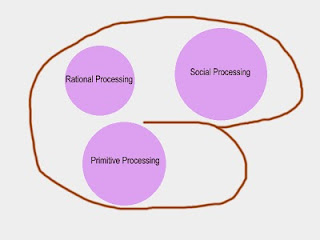
What becomes apparent when you talk to women is that there seem to be a variety of factors which contribute to the condition, but when you distill them they boil down to three factors: Instinctive, social and cognitive. Now if we assume that there may be cognitive process which correspond to these factors, much like Freudian theory (which I despise by the way) we can divide the female cognitive process into three sub entities which I will call Rational, Primitive and Social cognitive processes And by using this,try and construct a model of post-natal depression.
The Primal processes concerns itself with the operation of the primal functions, sex , eating mothering etc. The instincts.
The Rational processes concerns itself with day to day though processes and facts which we have been taught. (This bit of the brain is most influenced by education)
The Social processes concerns itself with the social dimension of our actions. (This bit of the brain is mostly influenced by perceived social convention and habit)
Now it's my belief that these cognitive process are probably "hardish" wired (i.e mostly genetically based and environmentally modified). But more importantly, the "weighting" that each of these is assigned by cognitive process is different in the sexes and this difference is by and large genetically determined, and it's this weighting which distinguishes the difference between male and female cognitive processes. Now if we attempt to illustrate this we get the following.
Girl Brain:
What we see here is that in a woman, her primitive and social processing seem to carry a greater weighting in her global cognitive processing. She is more likely to be influenced by feelings and social consequences and less influenced by rationality. Now I'm not saying that women are irrational, what I'm saying is that social and emotional factors have a much greater weighting in her cognitive functioning than in a man; an important distinction. ( With willed concentration i.e such as when performing a maths test, the weightings can change but this seems to be a task orientated phenomena and the system reverts to its default state once the task is finished)
Now post-natal depression can basically be thought of as an end result of the conflict between the three thought processes. This conflict gives rise to perceptible stress which over time leads to depression and feelings of detachment from the child.
Now the primal processes are what we commonly think as the "animal instincts" and are the ones seem most likely to be influenced by hormones, and it does seem to explain why some women are affected by hormonal issues when it comes to bonding with the baby. But what I postulate is just as some women are more "sexed" than others, it also appears that some women are more "motherly" than others. (perhaps there is a genetic basis to this) These "motherly" women derive pleasure from the mother baby interaction and the interaction is calming, not stressful. On the other hand, there are women who lack this "motherly" instinct or pleasure from bonding with their child, and it's these women who find mothering stressful and who probably form the group of women who want to work and not stay at home. These women may want to be good mothers but the mother baby thing just doesn't a happen. The cognitive processes are "expecting" the bond and joy of motherhood but its not there, stress ensures.
On the other hand, a woman who has a good mothering instinct but has been taught bad mothering skills, usually due to a desire to conform to social normal, will also experience stress in motherhood because of her inability to settle the child, breastfeed, etc. In this instance the source of stress comes from the conflict between the cognitive process and the mothering instinct. And while Mother wants to bond with the baby, the constant crying, feeding and sleep difficulties are source of stress which poison the relationship and her belief in herself.
Finally a mother who has good parenting skills and bonds well with the baby might also feel stressed and unhappy if she is placed in an environment which is hostile to motherhood. Such a woman may enjoy her child but become depressed due to the social opprobrium generated by other women.
The point here to realise is that there are several pathways which can lead to post natal depression and that trying to find that one size fits all cure, is likely to help only a small proportion of the women with the condition. Hormonal aberrations have been postulated as causes for PND, however many women with the condition don't have perceptible hormonal abnormalities, nor has hormonal therapy been accepted as a conventional therapy for this condition.
For motherhood to really work three things have to come together in synch. The mother must have a maternal instinct, she must be taught how to mother properly, society must view her role positively. Variations from this ideal will stress the mother in some way. In most women the stress generated is mild, but in those with cultural or genetic predispositions it's enough to lead to depression.
So what's all this got to do with Conservatism?
Firstly, the reality is that a significant portion of women are not born with a maternal instinct and the concept that a woman's natural place is in the home would seem to be at odds with the scientific evidence. It's an observed fact that some women, who are otherwise normal, find caring for children stressful to the point that it objectively injures their health. This is not my opinion, it's a fact.
Secondly, there is a growing body of evidence to suggest that whilst the maternal-child care arrangement is probably the best arrangement for looking after children, it's not necessarily so if the mother is having difficulties with the child. There is quite a bit of evidence to suggest the good child care is better than dysfunctional mothering.
Thirdly,given the given the differences in cognitive process between men and women, especially the fact that women give greater weighting to social and cultural factors, means that women are far more influenced by culture and opinion than men are. This fact has profound societal implications. The type of culture we expose our women to is the type of women they become. Men on the other hand tend to be culture resistant. Trying to indoctrinate men to like fat women is just not going to work since their cognitive processes are less influenced by culture.
Finally the mechanics of mother-child bonding parallels the mechanics of male-female bonding, as well as their pathologies. The insights gained from looking at the mechanisms of post natal depression lead directly to the insights of Game. The successful baby like like the successful male, pushes all the right buttons.
Monday, May 10, 2010
Bad Mother's Day
Jessica Rove is an Australian news presenter. Now I don't particularly care for Ms Rove but I do admire her coming out in the open about her own post natal depression and I feel this is one of the genuine instances where celebrities can actually do some good. Women, being more socially minded, tend to open about their problems if other women are doing so as well. Otherwise they are quite about the issue for fear of being "judged" by other women.High profile women(alpha females) set the social agenda and the issues they raise in public give other women permission, so to speak, to talk about them. Here in Australia there seems to be a recognition of the extent and perniciousness of depression in the community. It would appear that there is more talk about the subject than in the U.S or the U.K. Still many women suffer in silence, imagining that they are the only ones suffering from this condition.I imagine that part of the reason many women stay silent with regard to the condition is because of the social censure that has been put on "career women" by traditionalists, both male and female. Motherhood is still seen as a traditionalist domain where the traditionalists still have some authority on the subject. Opprobrium from this group of women carries particular weight. The tone of comments from this group has always been that a mother who pursues her career at the expense of spending time with her children is selfish and "unloving". The implication here being that a woman who stays at home loves her children more. The idea here is to make the woman guilty and to generate internal anxiety in the woman.
The assumption made by many traditionalists is that staying at home for a woman is of zero pscyhological consquence. In other words that staying at home will not do a woman any harm.
The problem is, that for some women, staying at home is injurous to their psychological health. The social isolation, lack of intellectual stimulation and predictable routine literally drive some women mad but it makes most women who aren't temperamentally suited to being at home depressed.
However the ideal of the the stay-at-home mum is so entrenched that many women who are not suited for it make a heroic effort at conforming to the ideal One of the interesting things I have noted in my experience of looking after the condition(PND), is just how much effort some women will put into being stay at home mums before they finally crack. Some never do however, and their children's childhood memories are filled with a mother who is constantly bitter and angry though officially conforming to the traditional mother role. Now, what was evident from Jessica Rove's story is that she had clearly planned to stay at home with the baby for a while, giving it what she thought was the best possible care. Still, despite her best efforts at motherhood, disturbing thoughts began to overwhelm her involuntarily. Her candid comments give an insight into how dangerous the condition is, frightening even its victim:
"The small silver Tiffany & Co. clock that I used to time my breastfeeds became a weapon in my mind. I wondered how easily the clock could crack my baby's delicate skull," Rowe writes in the January edition of Vogue.
"My eyes would be drawn to the sharp carving knife in the second drawer in the kitchen. I wondered if such a knife could pierce my little daughter's soft skin.
"I knew I would never hurt my baby but these bizarre thoughts . . . kept going around in my mind."
...........
While she put on a brave face after the birth of Allegra - a longed-for IVF baby - her dark thoughts spiralled out of control.
"I wrapped up the knife in newspaper and threw it away. I did this at night so the neighbours wouldn't see me," she writes. "I hid the silver clock, too, but even when these objects were out of sight they were still in my mind.
"Deep down I knew I needed help but I felt ashamed."
After six weeks of hell Rowe confessed to her husband, 60 Minutes reporter Peter Overton, she wasn't coping. "It was one of the hardest things I've ever had to do. I felt like I was letting him down too. He kept asking me if I was going to harm myself or Allegra. I told him of course I wasn't. But I knew I needed someone to pull me out of the anxious, frightening world my head was slipping into."
Here's another article that nicely illustrates what goes on these women's minds.
Now, it needs to noted that the Ms Rove did not will these thoughts, they were happening to her involuntarily and she was frightened by them. And despite the dreadful state that she was in, she still kept plugging away unassisted, because she wanted to be thought of as good mother, whatever the hell that means. Now, I think she gave a valiant enough shot at it and was smart enough to bail out before she did some harm to herself or the child, but notice what kept her back from seeking help; the perceived negative opinion of others and her own fear of admitting failure. She was trying so hard to live up to the ideal that she was putting welfare of her child and herself at risk. It needs to be noted that she approached motherhood positiviely and put effort toward the task. The problem was that the feels that arouse in her were involuntary, depsite wanting to be a good mother.
These involuntary thought processes are part and parcel of the chemical changes that happen in the brain as a result of being exposed to constant stress: The constant stress effectively bringing about depression. Negative ideation, anger, constant fatigue and obsessive thoughts are all symptoms of severe depression and it's why anti-depressants have a role in the early stages of PND; a quick fix method to restore the "chemical balance",buying time for longer acting therapies to work.
The point here that I'm trying to bring about is that for some women, motherhood is a constantly stressful experience and that people subject to constant stress become depressed. The assumption that all women find motherhood congruent with their natures is wrong. However, the other thing that is apparent is that not all women find motherhood a stressful experience, and it's these women that seem to thrive in it. So it would appear that at the extremes there are two groups of women; those who are stressed by caring for a child and those who are not.
Now the thing about a baby is that it can't communicate, it's unpredictable and demanding. It does not respect your right to sleep, eat or even go to the bathroom. Women whose personalities that tend toward an ordered, predictable and perfectionist existence have a hard time dealing with such a being. Their interactions with it are frequently stressful because of the conflict with their personalities and the reality of the baby. Their relationship becomes a disaster. As this woman points out:
My unrecognized descent into antenatal depression began with this loss of control. Postnatal depression gathered momentum as I found myself unable to cope with society's expectations and my own idealised views of me as a mother. Here I was, the typical high achiever, completely diminished by my experiences. I "failed" all aspects of my first pregnancy: contraception, pregnancy, natural childbirth, and then breastfeeding. I was to be the perfect herbal birth mother.
Now, it's these same personality factors which incidentally make for excellent employees. Particularly in the "white collar" type of jobs. Perhaps what underlies Catherine Hakim's Preference Theory, is that when given a genuine choice, women will choose life pathways that correspond best with their personality.
One of the blog commentators (and I'm sorry I can't remember who they were) gave an opinion that with increasing wealth in a society, women will assume greater roles in that society. Perhaps great push for female liberation beginning at the end of the 19th Century came about because women who were "stressed" in their domestic existence saw opportunities arise which allowed them to escape their depressing home lives. Now I need to stress, that many of these women were probably not motivated by malice towards men or hatred of the West, rather they simply and slowly were going mad at home and wanted to preserve their sanity. Their personalities weren't suited to domesticity and keeping them domestic made them miserable.
Or course women who were quite happy in their domesticity or motherhood were perplexed by the response of these women to their circumstances. How could a woman be unhappy with a good husband, material wealth and good children? Clearly there was something wrong with her, she must be a bad and selfish mother went their reasoning. She was bad because she was not toeing the line. The traditionalists and many of the religious agreed. The only group that offered them a sympathetic ear were the radical. Guess who became their friends?
Indeed, after a hundred or so years of mainstream feminism it's interesting to see how the shoe's on the other foot. Now its women who don't work who are deemed as having something wrong with them by the large cohort of feminist women in the work place. Women who choose to stay at home are called brain dead, chained to the sink, breeders etc. The sting is felt by lots of stay-at-home mums who feel that they haven't accomplished much by staying at home and raising the kids.
From a male's perspective, what's apparent is that both groups of women don't like each other, each side sniping at each other. Women it appears, don't like other women who don't make the same choices they make. Why?
It's my opinion that all women are to some degree naturally insecure and self-critical, and it's this insecurity that is the basis of the above behaviour. Women tend to group with other like women because there is safety in numbers, each tends to validate the other. Women on the other hand who step outside the group norms tend to invalidate the group, posing a challenge to the group and magnifying their anxiety. Getting other women to conform is a way of making women feel better about themselves. This is why women are always complaining about the "pressure to conform" something a lot of men look at and go "huh, what pressure.". Men are naturally less affected by self-criticism and insecurity are oblivious to this pressure. Men are much more confortable going alone. The pressure to coform is internally generated in the woman.
This need to be part of a group is also one of the complicating factors of PND. Every woman wants to be thought of as a good mother and being validated by other good mothers is one way of acheiving this goal. Therefore in the company of other women, a woman with PND will make a gigantic effort to appear that she is coping in order to gain group approval, since being outside the group generates further anxiety. In the end you have a woman who is not coping but making a despreate effort to appear that she is. Frequently in front of other women who are putting up the same appearance. In fact, I've had several instances where I have been treating women from the same mothers group, each think the other coping when in reality all were having a hard time.
A lot of the stress that comes about in early motherhood is a result of the mother's own expectations of the early child hood experience. Expectations that are formed both culturally and from the opinions of others. The ideal of a stay-at- home mother presumes that all women are capable of such an ideal. It also ignores evidence that suggests that the best care a child can recieve is from a happy mother, not from a full time miserable mother. The fact that many women are miserable staying at home looking after the kids would seem to suggest that it would be better that they more time out of the house and away from the children. Better a happy part-time mother than a miserable full-time one.
Still, while the myth persists that the best care a child can recieve is from a full time stay at home mum, many women will criticise themselves that they are bad mothers for finding the whole stay-at-home with the baby experience miserable. The reality is that nearly of these women are good mothers, its just that some of them aren't cut out to be stay-at-home mums.
For the record, I think Jessica Rove will make a fine mother.
Saturday, May 08, 2010
Natural Motherhood.
a) Put the child in childcare for a while.
b) That she try to get some work, part-time or full time.
The purpose of these two suggestions is to give the woman some pscyhological "breathing space" from the children. A place where she doesn't have to think about them constantly; some time where she can have to herself.
Now, with regard to childcare, I'm not particular concerned as to how she arranges things. If she has family supports, I'm quite happy for her to use them. But it's quite surprising to note just how many grandmothers do not want to take that role on, even for a few days. Some grandmothers are quite happy initially but then become resentful after a while. It would appear that many grandmothers, i.e older women are not keen to look after children when given a second chance. Once again the natural maternal instinct seems to be somewhat deficient in these women, and once again it would seem to refute the traditionalist idea that women naturally want to care for children, even their own.
On the other hand, there are plenty of grandparents who can get enough of the children, but this again would seem to confirm the idea that some women are naturally maternal where others are not.
My biggest problem in getting women to put their children in child care is other women: Particularly, natural mothers. That is women to whom motherhood is a constant joy. The problem here is that these women continually drop snide remarks toward those who put their children in child care. Women, being social animals, are far more sensitive to these remarks than men and are constantly on the defensive with regard to their reputation amongst other women. The net result is that a woman with post natal depression wants to get some space from the kids but feels guilty for wanting to.
The is a lot of contradictory evidence with regards to the benefits of child care. Personally I regard it as neutral. However the question that needs to be asked is, Do women with PND look after their children as well as a child care center? Several studies suggest not. The assumption, that the best care available to a child is by their mother, would appear to be wrong in some instances. A woman having a hard time off coping with her children is probably better off putting her child in child care.
If a woman's natural place is in the home, looking after the children, then it would seem to imply that women should possess the natural temperament to look achieve this. The reality is that a lot of women find looking after children highly stressful, stressful to the point that PND ensures. Some women aren't meant to stay at home with the kids.
Of course the charge is levied that these women are somehow deficient: They are selfish, ignore their children, don't love them etc. Some of them are. But the majority stick at job of motherhood till they drive themselves into the ground and reluctantly into my office. Most of them are embarrassed and ashamed that they can't cope and have arrived as a last resort after a prolonged and valiant effort. I have to pry them away from the myth that it all should come naturally to them: A myth perpetrated by Traditionalists.
From the above it would seem to imply that women can be divided into two groups; those who are natural mothers and those who are not. When in reality it's a spectrum with the two poles being the extremes. Most women are somewhere in between. It's this heterogeneity of temperament which probably explains Catherine Hakim's Preference Theory.
Tuesday, May 04, 2010
A Victorian Murderess.
A case currently before the courts, rather unfortunately illustrates some of the points that I was trying to make in My last Post.Donna Fitchett, murdered her two sons after drugging them. The sordid details can be found here. The usual insanity plea is being entered, though on my perusal of the available facts, there appears no evidence of insanity present. The appears to be no evidence of cognitive divorce from reality. Was is evident from the court reportage is that all the steps were deliberate and premeditated. Evil yes, but not insanity. In fact one bit of the testimony hinted at the diabolical nature of the evil:
Part-way through suffocating Matthew, the family dog became distressed and Fitchett had to take it outside so she could continue, the court has been told.Nature horrified in the presence of unspeakable evil.
For the record, this woman was suffering from depression, not post-natal depression: An important distinction, though she had suffered from post natal depression before. And while she does appear to be a sick woman, from the facts available, I do not believe the illness an important factor in the crime. Reading a bit more on the case, I feel that its highly likely that her own personality factors were probably a likely cause of her depression and the murders, but that of course is speculation, since the Australian media have very hard time of reporting anything accurately.
Still, what struck me in the above linked article was this bit of testimony:
After strangling Thomas with a pillow and stocking, she then bathed him because she did not want people to think he was not looked after, the court heard.Amongst all the turmoil that was going on in her mind; while cradling the dead body of her own child, murdered by her own hand, she was still concerned about the public opinion of her mothering skills. Her reputation mattered: Better be thought a murderess than a bad mother. And this is what you're up against sometimes as a doctor, a woman who would rather suffer and die rather than admit that she is having problems looking after her kids.
This is admittedly an very extreme case, but it does go to show just how important a woman's reputation is to her sense of self-worth. It also reveals why shaming is such a powerful mechanism in altering women's behaviour, it hits them where it hurts most; their reputation. We still live in a Victorian world.
Post-Natal Depression arises when the reality of motherhood conflicts with the expectations of motherhood. Now these expectations may be self inflicted--stupid ideas on how to raised children-- or peer pressured, but the reality is that a lot of women do not enjoy motherhood while at the same time strive to be good mothers. And motherhood is not enjoyable for these women because they are not designed to be mothers by temperament. Some women are better off leaving the care of their children to others; staying at home and looking after the kids is literally psychological torture for them. Leaving them at home to look after the kids is a recipe for disaster for the mother and the kids. The Traditionalist position--that the woman's natural place is in the home--is wrong: For some women it isn't. On the other hand, there are some women who absolutely love raising children and putting them into the workforce makes them miserable, they are not suited to it by temperament. The feminist position--that all women should work--is equally wrong. Catherine Hakim's findings confirm this.
The fallacy that many traditionalists, and indeed many women general make, is that a woman who does not want to physically care for her children obviously does not love her children. But there's a logic there that I can't see. After all, as the traditionalists assert, fathers love their children as much as the mothers even though they're away from the kids all day long ''at work". Proximity is a correlate and not a condition of love.
Indeed, the man who tried to save the murdered children was away at work whilst the woman who killed them was at home with them. Which one showed the greater love?
Sunday, May 02, 2010
Deprogramming.
As I mentioned in My previous post, part of the approach in dealing with women with post natal depression is to provide them with "counseling",which in reality it should be called deprogramming.Many of the women who suffer with PND are perplexed as to why they have the feelings that they are experiencing. Women, of course, have been taught that the maternal instinct is just that, a naturally occurring instinct which is meant to be present in all women, a natural bond that arises without effort in the presence of their own child. So when women find that they are having difficulty bonding with the child, or enjoying the experience, they become convinced that something is wrong with them.
It is hard to emphasise just how divorced from reality societal conceptions of motherhood are.
With the social atomisation of society, its quite surprising to note, just how many women do not have any experience with children until they have their own. Their conception of what childhood and motherhood are meant to be like is totally driven by perceived cultural norms. And the biggest cultural influence in our society is the media. Our media constantly bombard women and with images of smiling mothers with their smiling children: Love, cuddles, giggles and fun. The immediate post partum stage of childhood is never presented as a hard grind (which in reality it is) rather it is portrayed as a period of bliss and deep maternal love. So when a woman is not having a good time with her baby, she becomes convinced that there is something wrong, usually with herself. She thinks herself a bad mother.
This conclusion would not in itself be so damaging were it not combined with another factor; the concern with peer perception that is part and parcel of female nature: No woman wants to be thought a bad mother by other women. One of the critical factors that stops women from seeking help is their fear of what other people will think of them. It's only when the situation becomes critical or in some cases too late, is this struggle to preserve reputation overcome.
As I see it, a large component of PND is due to intellectual and cultural pathology. The process is as follows.
1) Women today have little direct experience of motherhood prior to having children. Women's expectations of motherhood are therefore derived from third party sources.
2) Women been taught that motherhood is natural to her.
3) Woman been taught that a baby brings happiness.
4) The woman does not experience happiness.
5) Since she has been told that she is meant to be happy and isn't, she concludes that there is something wrong with her.
6) However she refuses to seek help, since other people would think that she is a bad mother, because good mothers are able to engineer happy relationships with their children.
7) Therefore she suffers until the situation gets beyond her control.
The pathological mechanism in operation here is the conflict between her nature, the facts of the situation and the need to conform to perceived group norms. The conflict between what she is feeling and what she thinks she is expected to feel.
Therefore one of my first tasks with these women is laying out the truth, so to speak, about motherhood. Namely, that especially in the early stages, motherhood is a slog. No; it's quite normal to feel hostile to your child, when sleep deprived, stressed out, alone and not sure about what you are doing. Most of the mainstream advice about motherhood is bullshit, especially when it concerns issues of how you should feel with regard to your baby and so on. As I explain to these mothers, loving feelings may be fleeting or totally absent but you still have a duty of care. But perhaps most importantly of all, is that millions of other women feel exactly the same way about their babies. YOU ARE NOT A BAD MOTHER because you feel like you are doing it hard.
(Many new mums, who have raised the issue with other women privately in the same situations as themselves have been suprised to find that the other woman feels exactly the same way that she does.)
Frequently, when I give this talk, it is followed by a effusive display of sobbing, emotion and relief. It's as if a pressure relief valve has been opened. After first assessing the safety of the mother I spend several session with her to "deprogram" the mother with regard to the misconceptions of motherhood that have been planted in her head from whatever source. ( The Nursing Mothers Association deserve a special mention for their malignity in this situation--so many mothers have felt as failures because of their inability to breast feed.)
Now PND may first appear as a subject worthy medical interest only but reflection on the phenomena does yield insights into the operation of the female mind.
Firstly, most women strive to conform to ideals of the group, most women want to be good mothers. "Good" being defined by what other people or the culture thinks. Indeed public opinion seems to be given a greater weighting in the mind of woman than it does in a man; as a result, a woman is more of "public" person than a private individual. Secondly, her desires are frequently in conflict to public opinion but she is more likely to yield to opinion lest she earn opprobrium from the group. Game hints at this insight with its understanding of the importance of a man displaying high social worth. High social worth in this instance being high social worth as perceived by other women.
He wanted her, she'd never tell
secretly she wanted him as well.
But all of her friends stuck up there nose
they had a problem with his baggy clothes.
Avril Lavigne, Ska8ter boy
Women's choices are in part driven by other people's opinions, a phenomena that appears far less singnificant in men. Now, I'm not saying this is a bad thing, rather it needs to be recognised as a phenomena that is strongly expressed in female nature and it explains a whole lot of female behaviour. The pre-occupation with fashion, gossip, relationships and social events are all directed towards ascertaining what the social state of play is, what are the current group norms and which behaviours conform to them and which do not. Women are not only far more social than men, but far more likely to insist on conformity to group norms and to censure those who step outside the boundaries: They ensure sociability. Women's nature seems to be acutely sensitive in her relation to the contextual "in group", anxiety arising if she appears to be on the outer.
The other implication of this cognitive phenomena is that "fashion" is a powerful influence on behaviour; frequently in conflict with both intellect and primal desire. This is all fine if the "fashionable" group is healthy. But if the group is toxic, misery ensures. Several years ago, the sensitive new age man was all the rage, only to be dumped after he was found to be profoundly unsatisfying. He appealed to the intellect and fashion, but not to primal desire, hence the "conflict" of emotions. The currently bad boy fad, appeals to primal desire and fashion but not the intellect and it too will lead to frustration.
It also need to be recognised that this phenomena in women, is both a weakness and strength. A weakness in the sense that woman's own nature compromises her independence: she may want to act independently, but suffers because of it, which in turn makes independent action less likely. However her weakness is a strength in the sense that the weakness promotes social cohesion by setting the norms of the behaviour of women primarily and men secondarily. Fashion is a far greater influence on behaviour than argument.